Sales teams often start with the obvious use case: write an email. ChatGPT Business can help with that, but the stronger value is upstream and downstream of the email: understanding the account, framing the pain, preparing questions, summarising calls, and turning follow-up into a repeatable standard.
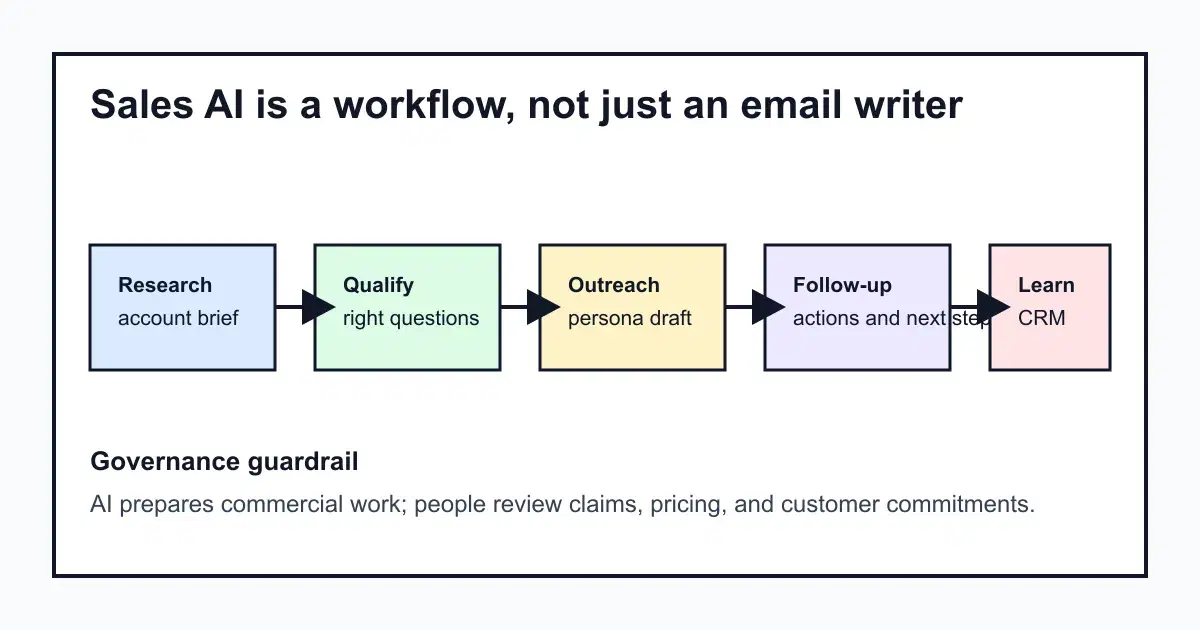
Useful sales workflows
- Account research: turn public information into a concise discovery brief.
- Qualification: prepare questions that test budget, urgency, authority, and risk.
- Outreach: draft variants by persona without losing the core proposition.
- Follow-up: convert call notes into actions, objections, and next-step emails.
Governed sales AI beats random prompting
An AI lead-generation platform and ChatGPT Business solve different parts of the sales problem. Use a specialist prospecting platform when you need contact databases, intent signals, enrichment or automated sequencing. Use ChatGPT Business when the bottleneck is research, qualification, message preparation, call summaries, proposal drafting and repeatable sales judgement. Many teams need both. The buying test is whether the tool improves a measurable stage of the funnel and fits your CRM, data rules and review process—not whether it can generate another cold email.
A sales prompt library worth building
Next step
Plan a governed ChatGPT Business rollout
Book a call to scope workspace ownership, starter workflows, and governance for your team.
Book a rollout call- Account brief prompts for sector, trigger events, likely pains, and discovery angles.
- Persona prompts for finance, operations, IT, and owner-manager concerns.
- Objection prompts for price, risk, implementation effort, and internal timing.
- Follow-up prompts that turn notes into actions, recap emails, and CRM fields.
The goal is not to automate judgement out of sales. It is to remove blank-page work, improve preparation, and make good follow-up more consistent. Human review remains essential whenever the output includes claims, pricing, promises, or customer-specific recommendations.
AI Build Group helps sales and leadership teams identify the workflows where ChatGPT Business can improve throughput while keeping review and governance practical. Request partner pricing and sales workflow support to turn AI interest into a usable sales system.