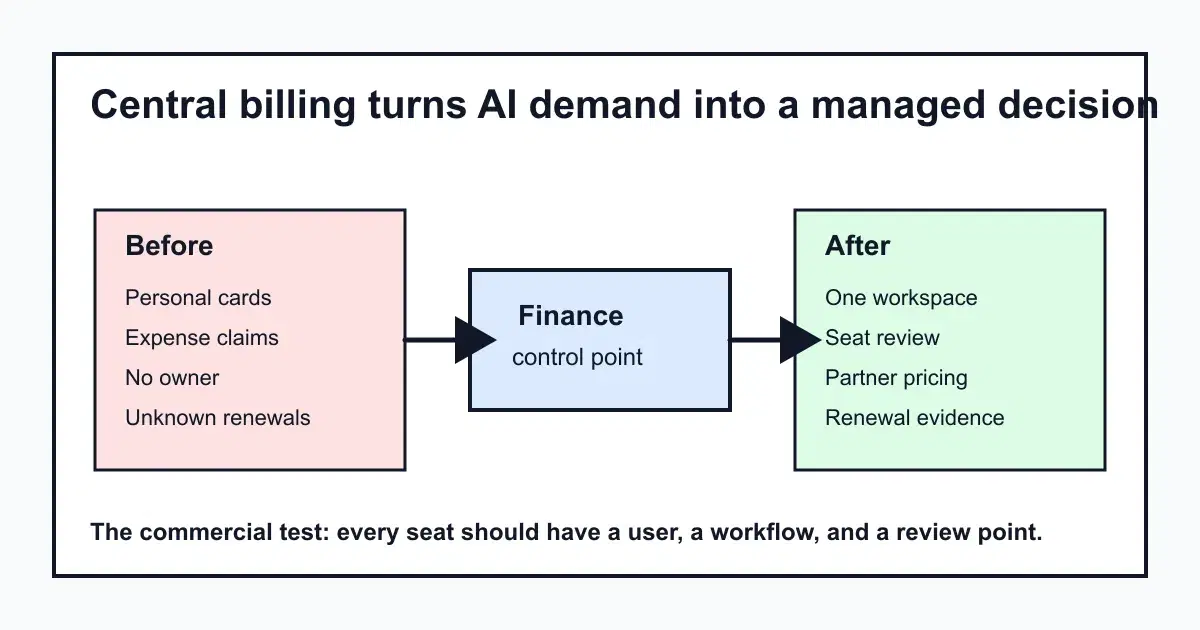
**In brief:** ChatGPT Business central billing replaces scattered employee subscriptions with an organisation-managed commercial workspace. Finance gains a clearer view of seats and responsibility, while IT has a defined place to manage access. Request ChatGPT Business partner pricing through AI Build Group.
Why personal AI subscriptions become a finance and governance problem
Personal subscriptions are easy to start and difficult to govern. They may sit on employee cards, expenses or departmental budgets, with no consistent joiner and leaver process. The cost is only part of the problem: the organisation may not know who owns the account, what business work sits inside it or whether a departing employee still controls important prompts, projects and working practices.
What central billing changes
- A company-owned workspace rather than unrelated consumer accounts.
- A clearer view of active members and commercial responsibility.
- Seat management connected to normal employment and contractor processes.
- Less duplicated or abandoned subscription spend.
- A defined administrator and escalation route.
- A better basis for measuring adoption and value by team.
Business vs Plus vs Enterprise: how billing differs
Next step
Plan a governed ChatGPT Business rollout
Book a call to scope workspace ownership, starter workflows, and governance for your team.
Book a rollout callFor finance, there are three different buying models to separate. ChatGPT Plus is an individual subscription. Self-serve ChatGPT Business creates a company-managed workspace with central seat administration and billing, but OpenAI currently requires credit or debit card payment for the remaining amount due; invoice billing, bank transfer, wire, ACH, purchase orders and net terms are not available for self-serve Business. ChatGPT Enterprise is a contracted plan: the agreement sets the billing period, invoice schedule and payment terms, so it is the appropriate route when procurement requires formal invoicing or negotiated commercial terms. Business users can still view past invoices/receipts in workspace billing, but that is different from being allowed to pay by invoice.
A practical seat-planning process
- Identify current users, including reimbursed and privately funded accounts used for work.
- Choose a pilot group around two or three measurable workflows.
- Assign a business sponsor, primary administrator and backup.
- Define how seats are requested, approved, reassigned and removed.
- Review usage and outcomes before expanding access.
- Retire duplicate subscriptions only after migration has been checked.
What AI Build provides
AI Build Group helps UK organisations compare buying routes, request partner pricing, plan the initial workspace and move users into a managed rollout. Qualifying purchases include two hours of complimentary remote setup. Optional support covers governance, training, integrations and workflow automation.
Get ChatGPT Business partner pricing
What you gain from ChatGPT Business central billing UK
Replace scattered personal AI subscriptions with central ChatGPT Business billing, managed seats and partner pricing for eligible UK organisations.
Book a rollout callRequest your partner offer from AI Build Group. We will confirm eligibility, explain the current buying route and help you plan a controlled first deployment. Get ChatGPT Business partner pricing.