Advanced ChatGPT features can look impressive in a demo and still fail to change everyday work. Business value appears when teams connect those capabilities to real tasks: drafting, analysing, summarising, checking, planning, and improving decisions with a consistent method.
Where advanced tools help first
- Document work: turn rough notes into structured drafts, summaries, and review checklists.
- Analysis: explore options, compare trade-offs, and prepare explanations for stakeholders.
- Knowledge reuse: convert repeated questions into reusable prompts and examples.
- Quality control: use review prompts to spot missing assumptions, risks, and next actions.
Training matters more than feature lists
A team does not need a tour of every advanced capability on day one. It needs examples that match its work. That is why a managed rollout should include workflow selection, prompt patterns, review rules, and feedback loops. The tool becomes advanced when the operating pattern is advanced.
The repeatable pattern
Next step
Plan a governed ChatGPT Business rollout
Book a call to scope workspace ownership, starter workflows, and governance for your team.
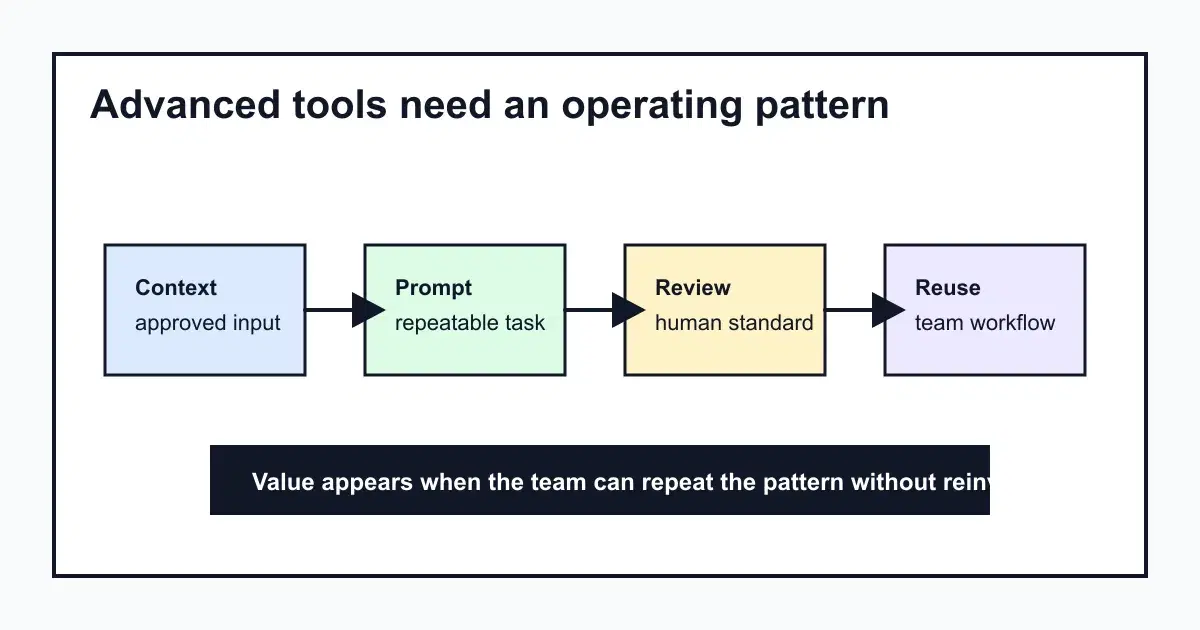
Book a rollout call- Context: give the model approved inputs, constraints, and role expectations.
- Prompt: turn the task into a reusable instruction rather than a one-off request.
- Review: define what a human checks before the output is trusted or shared.
- Reuse: save the workflow so the team improves it instead of starting from scratch.
That pattern is what stops advanced tools becoming a novelty. It helps new users learn faster, gives confident users a standard to improve, and gives managers a way to discuss quality without policing every prompt.
AI Build Group helps teams turn ChatGPT Business features into practical, governed workflows rather than isolated experiments. Book a partner-led rollout conversation if you want advanced tools mapped to real team work.