How much does ChatGPT Business cost in the UK?
On OpenAI’s UK chatgpt.com checkout on 18 September 2026, Standard seats were £15 per user per month billed annually, or £18 per user per month billed monthly, exclusive of VAT, with a two-seat minimum. Enter a UK VAT number to keep VAT off the invoice. OpenAI Help still lists $20 / $25 USD as the international rate. Confirm the live chatgpt.com figure before you raise a purchase order.
How much is ChatGPT Business in the UK?
UK checkout is £15 per Standard seat per month on annual billing, or £18 monthly, exclusive of VAT, with a 2-seat minimum — checked 18 September 2026 on chatgpt.com. VAT is added unless you enter a valid UK VAT number. OpenAI Help’s international list remains $20 annual / $25 monthly USD.
How much is ChatGPT in the UK?
ChatGPT Business on OpenAI’s UK checkout is £18 per user per month billed monthly, or £15 per user per month billed annually, exclusive of VAT, with a two-seat minimum (chatgpt.com, 18 September 2026). ChatGPT Plus is a personal plan and is not this team price. Confirm the live chatgpt.com figure before you budget.
How much is ChatGPT per month in the UK?
The UK monthly price for a ChatGPT Business Standard seat is £18 per user, exclusive of VAT. Annual billing is £15 per user per month. Both need at least two seats. Premium seats were £90 monthly or £75 annual, exclusive of VAT, and are not the standard monthly figure. Checked 18 September 2026.
Does ChatGPT charge VAT in the UK?
Yes, unless you enter a valid UK VAT number at checkout. UK ChatGPT Business prices are exclusive of VAT, and 20% VAT is added when no VAT number is entered. A valid UK VAT or Tax ID keeps VAT off the invoice.
Is there VAT on a ChatGPT subscription in the UK?
There is VAT on a UK ChatGPT Business subscription when you do not enter a valid UK VAT number. The £18 monthly and £15 annual Standard rates are exclusive of VAT, so 20% is added at checkout in that case. A valid UK VAT number keeps VAT off the invoice.
What is the ChatGPT Business minimum number of seats?
Two standard seats. You cannot run a ChatGPT Business workspace on a single seat. That is why a personal ChatGPT Plus login is not a substitute for a two-person team workspace.
Is ChatGPT Business priced in GBP or USD, and do I pay VAT?
UK organisations see OpenAI’s ChatGPT Business checkout in pounds, labelled exclusive of VAT. Enter a valid UK VAT/Tax ID at checkout to treat the purchase as VAT-exempt; otherwise 20% VAT is added. OpenAI Help still publishes the international list in USD ($25 monthly / $20 annual). A UK partner quote may also be issued in GBP after eligibility review.
Is there a real ChatGPT Business promo code or discount?
Yes — but only as a genuine OpenAI SMB Channel Partner offer after an eligibility check, not as a public coupon scraped from voucher sites. Request a code on the ChatGPT Business get-offer page. AI Build Group emails eligible UK and Ireland codes, usually within one business day.
How much does ChatGPT Business cost per user?
On OpenAI’s UK checkout, Standard seats are £18 per user per month billed monthly, or £15 per user per month billed annually, exclusive of VAT, with a 2-seat minimum — checked 18 September 2026. OpenAI Help lists $25 / $20 USD internationally. UK partner discount codes and free-seat pilots can change the partner quote — request a code on the get-offer page.
Is ChatGPT Business cheaper annually?
Yes on OpenAI’s UK checkout. Annual billing was £15 per Standard seat per month versus £18 monthly, exclusive of VAT, on 18 September 2026. The 2-seat minimum still applies. Confirm the live chatgpt.com rate before you commit.
Is ChatGPT Business suitable for UK SMEs?
Yes, when two or more people already use ChatGPT at work and you want central billing, admin controls and business data protections without Enterprise extras such as SCIM, exportable audit logs or a formal SLA. The UK checkout has a two-seat minimum. AI Build Group, a UK OpenAI SMB Channel Partner, helps SMEs move from personal accounts to a governed workspace without changing OpenAI’s product.
Are there additional implementation or support costs?
Yes if you want licences to stick. Budget onboarding, an AI use policy, starter workflows, and optional workspace credits beyond per-seat limits. Two hours of complimentary remote setup can be included on qualifying UK and Ireland partner purchases; extra governance or training is scoped separately. Request those extras on the ChatGPT Business partner discount code page.
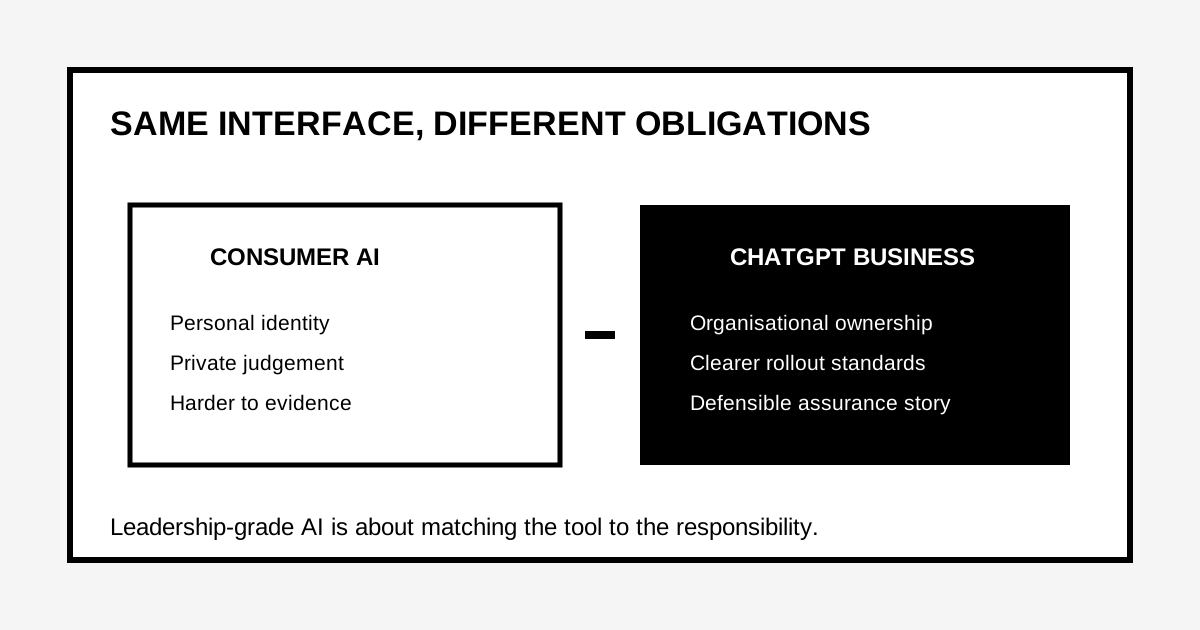
What is the difference between ChatGPT Plus and Business?
ChatGPT Plus is a personal subscription with consumer terms and no organisation admin. ChatGPT Business is the team plan: central billing, admin controls, SAML SSO, and business data protections. UK Standard seats were £18 monthly / £15 annual excl. VAT on 18 September 2026, with a two-seat minimum. Plus cannot be upgraded into a one-seat Business workspace.
How does buying ChatGPT Business through an OpenAI SMB Channel Partner work?
The product remains OpenAI’s ChatGPT Business. A UK OpenAI SMB Channel Partner such as AI Build Group can run an eligibility check, issue a genuine partner discount code, provision the workspace, and — on qualifying UK and Ireland purchases — include two hours of complimentary remote setup. Some partners can invoice in GBP. Current offer terms are confirmed on the get-offer page, not guessed from coupon sites.
What does AI Build provide alongside the ChatGPT Business licence?
AI Build Group does not replace OpenAI as the product vendor. Alongside the licence it can add a partner discount code where eligible, two hours of complimentary remote setup on qualifying purchases, and optional governance, training, or adoption consulting from the same UK team. Request those extras on the get-offer page.
Is Business cheaper than ChatGPT Plus for teams?
For teams, Business often costs less per person than everyone buying Plus individually once central billing and admin controls are included — plus you eliminate unmanaged shadow AI risk.
Does ChatGPT Business pricing change with team size?
The per-seat rate stays consistent; total spend scales linearly with the number of seats you provision — five seats costs five times the per-seat rate, fifty seats costs fifty times, with no volume discount tier below Enterprise. Most UK SME rollouts start with a small pilot cohort and expand seats once adoption metrics justify it, rather than licensing the whole organisation on day one.
What counts toward ChatGPT Business total cost of ownership?
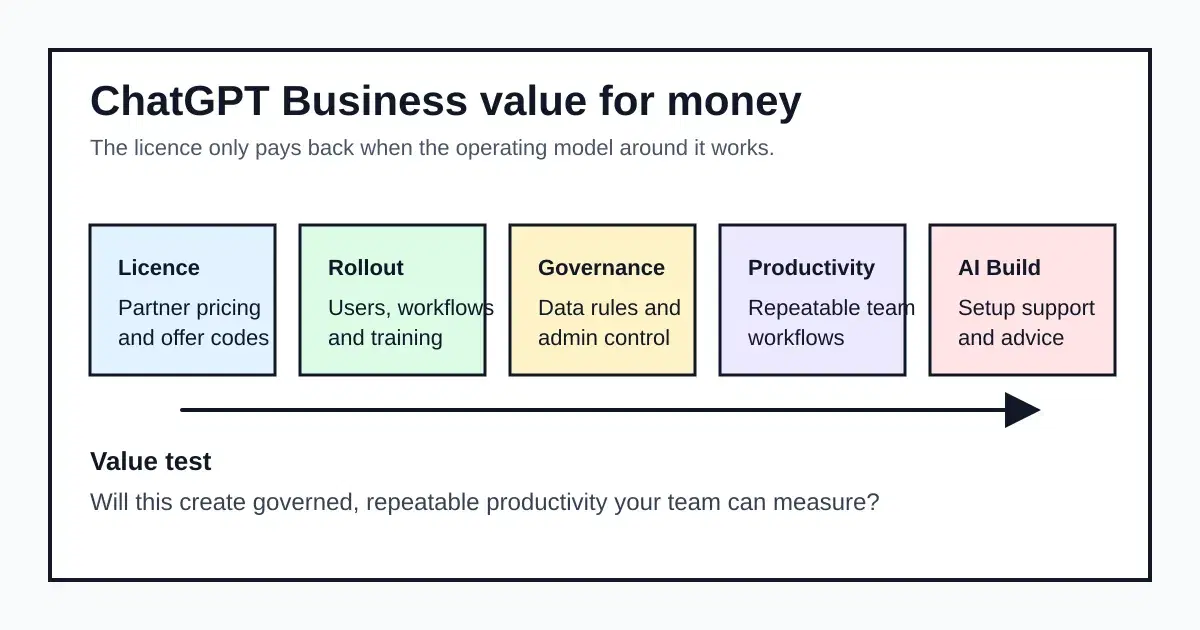
Per-seat subscription cost, onboarding and workspace configuration, governance and AI use policy work, optional workspace credits, and workflow design or pilot training time. The subscription line is usually the smallest of these once you account for a proper rollout.
Should we budget for implementation?
Yes. Licence cost alone does not cover policy templates, pilot users, training, or measurement. Most UK SME rollouts include modest onboarding effort in weeks two to six.
Where do I get a ChatGPT Business partner discount code?
Request one from the ChatGPT Business partner offer page. AI Build Group emails eligible UK and Ireland codes after a quick eligibility check, usually within one business day.
What does ChatGPT Business pricing look like for a 25-seat team?
At OpenAI’s UK checkout on 18 September 2026, 25 Standard seats run £450 per month billed monthly, or £375 per month (~£4,500 per year) billed annually, exclusive of VAT — before any partner discount code or free-seat pilot. See the cost ladder above for 5, 10, and 50-seat figures, and verify the live chatgpt.com rate before finalising a budget.
Is Microsoft 365 Copilot cheaper than ChatGPT Business?
Not usually, once you count the required Microsoft 365 base licence. Copilot's add-on price is roughly $21–30 per seat per month, but it needs an eligible M365 base plan underneath, pushing the realistic all-in cost to somewhere around $34–90 per seat per month. ChatGPT Business is a standalone UK checkout of £18 monthly / £15 annual per Standard seat excl. VAT, with no base licence required — verify current Microsoft pricing before you compare, since figures vary by tier and region.
What ROI formula should we use to justify ChatGPT Business pricing?
(Hours saved per seat per week × hourly cost × seat count × 52) minus (annual licence cost plus rollout cost) equals net annual value. Use a conservative, function-specific benchmark for the hours-saved figure — McKinsey's research on generative AI documented a 14% gain in per-hour issue resolution and a 9% cut in handling time for one customer-service function — then replace that benchmark with your own pilot data once you have real usage.
Are workspace credits and Codex included in ChatGPT Business pricing?
Standard seats include baseline ChatGPT and Codex access within the per-seat limits, but usage beyond those limits requires optional, pooled workspace credits that a workspace owner purchases separately. Usage-based Codex seats with their own credit requirements are no longer available to new Business workspaces, or to workspaces that never added one before 24 June 2026 — confirm current terms on OpenAI Help before budgeting for standalone Codex seat usage.