Who should attend training first?
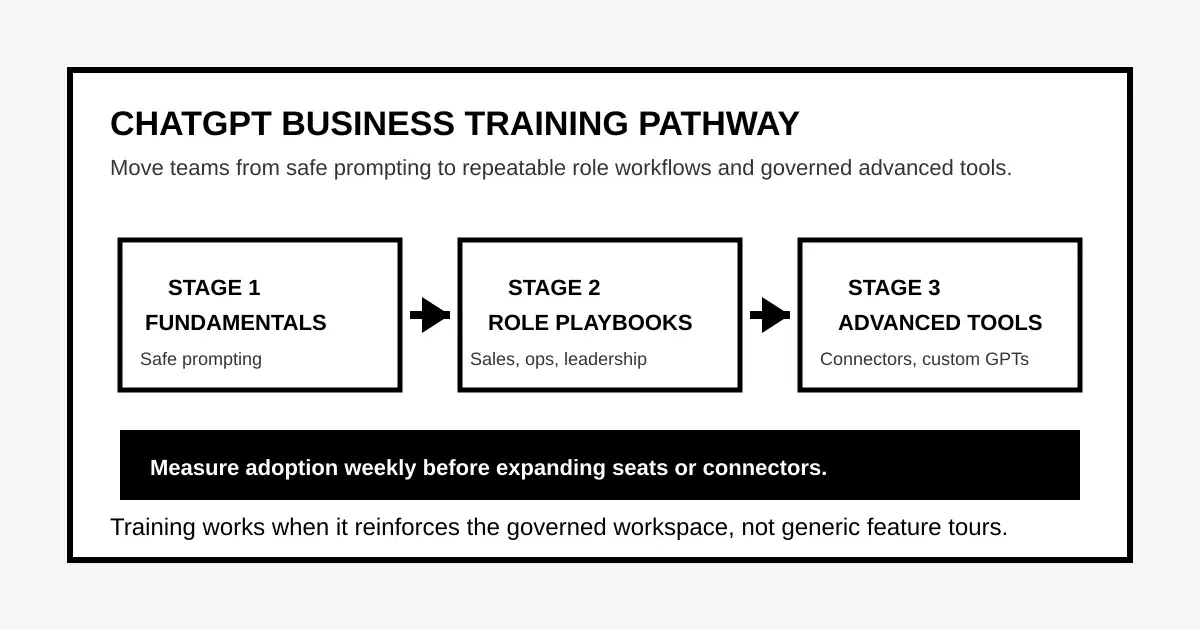
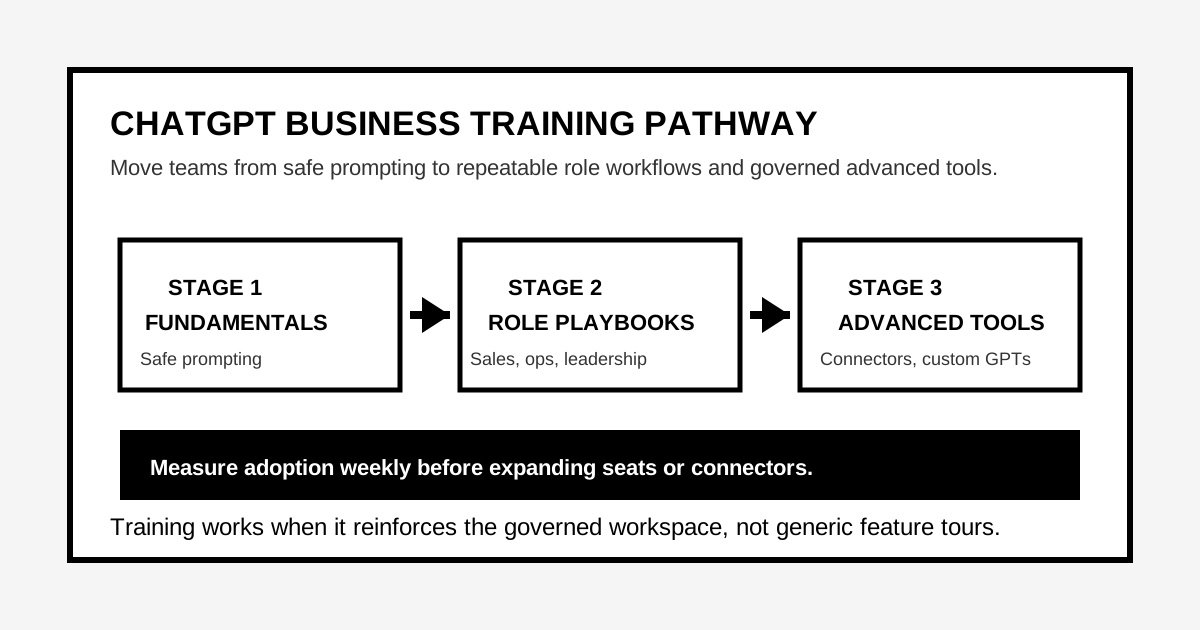
Pilot users and team leads who will model safe usage, plus the workspace owner, complete the 101 fundamentals session first. Expand to 201 role playbooks once pilot workflows show consistent review-gate quality — not on a fixed calendar date regardless of readiness.
How long does training take?
101 fundamentals fit a single 90-minute session for the full pilot cohort. 201 role playbooks add one workshop per function. 301 advanced tools follow once pilot adoption metrics — not a fixed date — justify connector or custom GPT expansion.
What is the difference between the 101, 201, and 301 training stages?
101 covers safe prompting, review gates, and data red lines for everyone. 201 adds role-specific playbooks — sales, operations, leadership, finance, and technical tracks each get a workshop built around workflows that team already does. 301 introduces connectors, file analysis, and custom GPTs, gated behind pilot adoption metrics rather than opened to everyone on day one.
Can training be customised for our sector?
Yes. Corporate programmes use your workflows, policies, and examples — construction, professional services, financial services, and operations-heavy sectors each get sector-specific data red lines and starter workflows rather than a generic deck.
Does training include governance?
Every programme covers data red lines, review gates, and escalation paths at the 101 stage before any role playbook begins — training without governance recreates the exact shadow AI risk a governed workspace is meant to remove.
Is ChatGPT Business training available online or only in person?
Both. Live webinars and structured courses run online; bespoke corporate programmes can be delivered on-site, virtually, or blended depending on your team's preference and how distributed your pilot cohort is.
Do we need training if staff already use ChatGPT personally?
Yes — personal experience with consumer ChatGPT does not cover admin controls, data red lines, or the approved workflows specific to your workspace. Training bridges the gap between casual use and governed, repeatable work, and the 101 module is deliberately built around that gap rather than basic product familiarity.
How many staff should be in a training cohort?
101 fundamentals works well for a full pilot cohort of up to around 15–20 people in one session. 201 role playbooks run smaller — typically one function at a time — so the starter workflow genuinely reflects that team's real work rather than a lowest-common-denominator example.
What adoption metrics do you track after training?
Weekly active seats as a proportion of provisioned seats, the number of approved starter workflows genuinely in weekly use per team, and spot-checked review-gate compliance on client-facing output — checked at day 30, day 60, and day 90 against the initial baseline, not just attendance at the launch session.
Do sales, operations, leadership, and finance teams get different training?
Yes. The 201 stage runs a separate role track for sales, operations, leadership, finance and procurement, and technical/IT teams — each with its own governance red lines and a starter workflow scoped from that function's real weekly work, not a shared generic workshop.
What happens if pilot adoption metrics stay flat after 30 days?
We revisit the 101 habits and starter workflows before expanding to 201 role playbooks or adding seats — flat weekly active-seat numbers usually mean the starter workflow was not useful enough, not that staff are uninterested in AI. Fixing the workflow fit is almost always cheaper than running more workshops on the same content.
Can training happen before the ChatGPT Business workspace is fully provisioned?
The 101 module can run as an awareness session before provisioning, but hands-on practice needs live workspace access — we typically sequence provisioning and the first 101 session within the same week so training turns into habits immediately rather than being forgotten before seats are live.
Who actually delivers the training sessions?
A small, named AI Build Group delivery team runs both the public catalogue sessions and bespoke corporate programmes — the same practitioners who scope governance and rollout, not a rotating bench of freelance trainers. For corporate programmes, the person who runs your 101 fundamentals session is usually the same one delivering the 201 role playbooks that follow.
What happens to training if we later move some staff to ChatGPT Enterprise?
The 101/201/301 pathway and role playbooks carry across largely unchanged, since the underlying habits — safe prompting, review gates, data red lines — do not depend on which ChatGPT plan a seat sits on. We adjust the 301 advanced-tools module to reflect any Enterprise-only features (such as SCIM provisioning or selectable data residency) that become relevant once seats move.