AI Build Group · Executive assessment

How mature is your organisation’s use of AI?

Complete the AI Maturity Assessment to see where your organisation currently stands, what is holding it back and which controlled workflows could create measurable value next. An AI readiness assessment asks whether foundations exist; maturity asks whether AI has become a repeatable, governed capability.

In brief

AI maturity measures whether generative AI is a repeatable, governed capability — not just licences or isolated experiments. AI Build Group’s free assessment scores six dimensions in about five minutes and delivers a personalised Word report with strengths, constraints, and a practical 90-day roadmap for UK leadership teams.

  • Six maturity dimensions
  • 20 evidence-led questions
  • Personalised management report
  • Practical 90-day roadmap

Direct answers

AI maturity assessment answers

What is an AI maturity assessment?
An AI maturity assessment scores how far AI has moved from isolated experiments to repeatable, governed capability across strategy, people, process, governance, improvement, and transformation. AI Build Group’s free online assessment takes about five minutes and produces a personalised report with a 90-day roadmap.
How is AI maturity different from AI readiness?
AI readiness asks whether foundations exist — budget, sponsor, basic tooling, and permission to start. AI maturity asks whether AI is already a repeatable, governed capability with owners, controls, and measurable outcomes. You can be ready and still immature; licences and prompt counts prove neither on their own.
What should a 90-day AI roadmap for a UK SME include?
Days 0–30: ownership, constrained pilot workflows, controls, and baselines. Days 31–60: controlled pilots with exception logging and output review. Days 61–90: compare outcomes to baseline, then approve, amend, or stop each workflow before standardising. AI Build Group’s assessment report drafts that sequence from your scores.
Who should take the AI maturity assessment?
Operations, IT, transformation, or programme leaders evaluating the next credible AI step — not only data scientists. The report is written for executives who need a score, category breakdown, and practical next actions rather than a generic maturity buzzword deck.
What do I receive after the assessment?
A maturity band, category scorecard, strengths and constraints, workflow opportunities, governance considerations, and a practical 90-day roadmap — delivered as a personalised Word report after a short request form. Optional facilitated follow-on workshops deepen the plan with leadership.

AI readiness vs AI maturity

Readiness asks whether the foundations exist. Maturity asks whether AI has become a repeatable, governed and measurable part of how the organisation operates. Buying licences or counting prompts does not demonstrate maturity. The goal is controlled workflows tied to business outcomes, with accountable people retaining professional, commercial, regulatory and release decisions.

QuestionAI readinessAI maturity
Primary askCan we start safely?Is AI already a governed capability?
Typical signalsSponsor, budget, tooling accessOwners, controls, measured workflows
Common false proofLicences purchasedPrompt volume or seat count
Next useful outputPermission to pilot90-day roadmap from evidence
  1. Isolated individual assistance
  2. Approved team use
  3. Controlled workflows
  4. Measured operational outcomes
  5. Reusable organisation-wide capability

What the assessment measures

Twenty questions across six dimensions. Each answer uses a 0–4 scale. Category maxima total 80 points.

  • 4 questions · max 16

    Leadership and strategy

    Direction, sponsorship, prioritisation and alignment with business objectives.

  • 3 questions · max 12

    People and skills

    Role-based capability, approved use and retention of accountable human judgement.

  • 4 questions · max 16

    Process maturity

    Documented processes, standard work, inputs, hand-offs, exceptions and approval points.

  • 4 questions · max 16

    Governance and control

    Approved sources, confidentiality, traceability, validation and controlled release.

  • 3 questions · max 12

    Continuous improvement

    How employee-created ideas are captured, evaluated, piloted, standardised and scaled.

  • 2 questions · max 8

    Business transformation

    Whether AI adoption is measured through workflow and business outcomes rather than tool activity.

Loading assessment…

What the participant receives

After lead capture, AI Build Group emails a personalised report explaining the evidence behind each score, company-specific workflow opportunities, governance considerations and a 90-day roadmap. The automated report is directional: it separates assessment responses, public website-derived context and AI Build recommendations. It is not an audit or certification.

  • Overall maturity result and band
  • Category-by-category scorecard
  • Explanation of the evidence behind each score
  • Strengths and constraints
  • Company-specific workflow opportunities
  • Priority findings and governance considerations
  • Practical 90-day roadmap
  • Next maturity objective and reassessment baseline

Recommendations suggest opportunities for controlled pilots. They do not promise savings without a validated pilot.

Example workflow opportunities

Recommendations are tailored to your responses and company context. Safe examples of where AI often supports information handling, drafting, comparison and preparation include:

  • · Enquiry, quotation and proposal preparation
  • · Project documentation and customer reporting
  • · Quality and compliance reporting
  • · Meeting and action summaries
  • · Policy and procedure maintenance
  • · Controlled document generation
  • · Employee improvement-idea capture and scaling

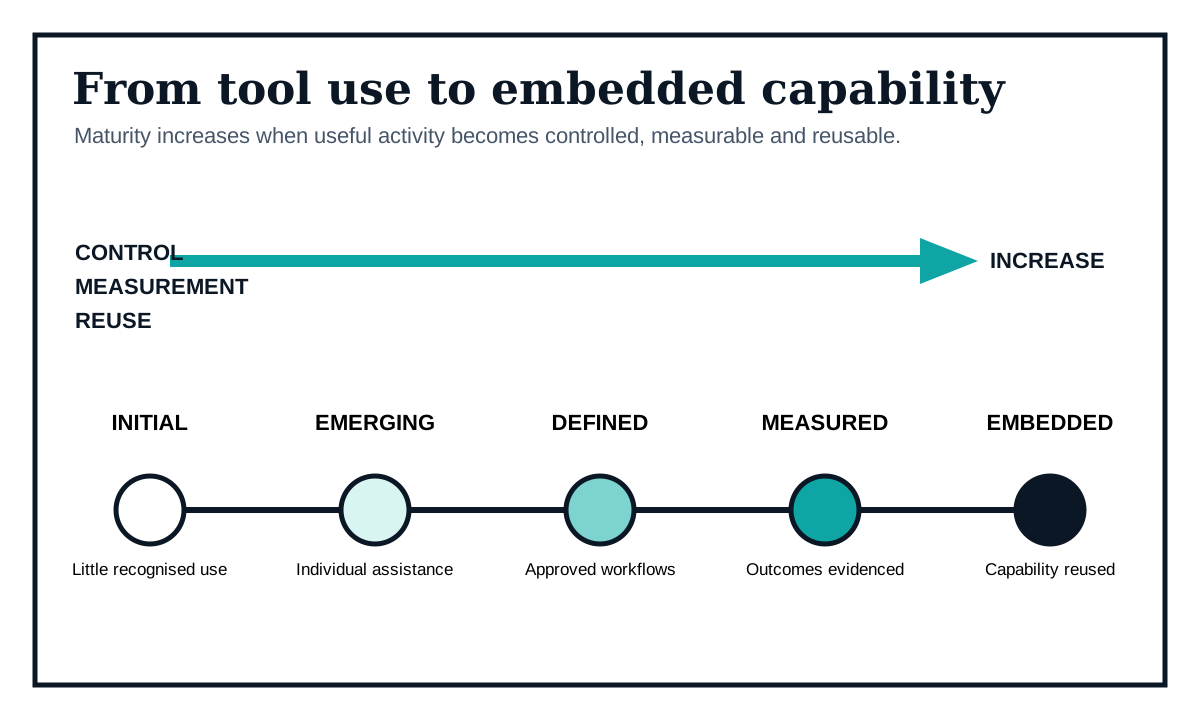
Maturity progression

The objective is not necessarily to maximise every score immediately. Improve the areas that constrain your most valuable controlled workflows.

  1. 020%

    Initial

    AI use is informal or limited to individuals. Foundations for repeatable, governed workflows are not yet in place.

  2. 2140%

    Emerging

    Some teams are finding value, but adoption remains inconsistent. Successful practices are not routinely standardised or scaled.

  3. 4160%

    Defined

    Approved patterns and processes are emerging. Leadership, skills and controls are becoming coordinated, though outcomes may still be uneven.

  4. 6180%

    Measured

    Controlled workflows are in use with measurable operational effects. Governance and improvement loops are active for priority areas.

  5. 81100%

    Embedded

    AI-supported workflows are a repeatable, governed part of how the organisation operates, with accountable people retaining important decisions.

Initial → Emerging → Defined → Measured → Embedded

90-day AI roadmap for UK SMEs

After the assessment, leadership needs a funded sequence — not a vague transformation programme. This 90-day AI roadmap is the default shape of the personalised report: prove one or two controlled workflows before scaling seats or connectors.

Days 0–30

Confirm ownership, select constrained workflows, document the process and define controls and baseline measures.

Days 31–60

Run controlled pilots, capture exceptions, review outputs and measure operational effects.

Days 61–90

Compare outcomes with the baseline, then approve, amend or stop each workflow. Standardise only demonstrated successes.

Benchmarking and reassessment

The assessment is the foundation of AI Build Group’s AI Maturity Benchmarking Club. Participants can reassess after ninety days or another sensible interval. The report compares the organisation with its own previous result when historical data exists. Anonymised aggregate benchmarking may be added when the dataset is large and representative enough.

Maturity bands above are illustrative score ranges, not published industry averages. Real peer placement is only shown when genuine anonymised comparison data exists.

Review your results with AI Build Group

Book a management review to validate the findings, select the first controlled workflow and agree what should happen during the next ninety days. Relevant follow-on work may include AI strategy and workflow consulting, ChatGPT for Business, OfficeMaker, HCL Domino Assistant, SAVI.education training or tailored workflow automation — only where your evidence supports it.

Book a management review

Frequently asked questions

What is an AI maturity assessment?

An AI maturity assessment measures how far an organisation has progressed from informal individual AI use to governed, repeatable and measurable AI-supported workflows. AI Build Group’s online assessment scores twenty evidence-led questions across six dimensions and produces a personalised management report.

What is the difference between AI readiness and AI maturity?

AI readiness asks whether foundations exist to adopt AI safely — sponsor, budget, basic tooling, and permission to start. AI maturity asks whether AI is already a repeatable, governed, measurable capability with owners and controlled workflows. An organisation can be ready and still immature; seat counts and prompt volume prove neither on their own.

What does a 90-day AI roadmap for a UK SME include?

A practical 90-day AI roadmap sequences ownership and baselines (days 0–30), controlled pilots with review gates (days 31–60), and decide-to-standardise outcomes against those baselines (days 61–90). AI Build Group’s assessment report drafts that roadmap from your maturity scores so leadership can fund the next controlled workflow rather than a vague transformation programme.

How is the score calculated?

Each of the twenty questions is scored from 0 to 4. Category totals use fixed maxima (Leadership 16, People 12, Process 16, Governance 16, Continuous improvement 12, Business transformation 8). The overall score is out of 80 and is also shown as a percentage band from Initial to Embedded.

What information do I need to provide?

After the questions you provide your name, work email, organisation, role, company website and company size, plus consent to receive the assessment report. You can review and correct core company details before submission.

How is my company website used?

We use your public website to make the report more relevant to your sector, operations and likely workflow opportunities. Website-derived context is indicative and is kept separate from your assessment responses. It does not independently verify internal company operations.

What will my report contain?

Your personalised report explaining the evidence behind each score includes your overall maturity result, category scorecard, strengths and constraints, company-specific workflow opportunities, priority findings, governance considerations, a 90-day roadmap and a baseline for reassessment.

Is this an audit or certification?

No. The automated report is directional management guidance based on your responses and public website context. It is not an independent audit, regulatory opinion or certification.

How long does the assessment take?

Most respondents complete the twenty questions in about three to five minutes, then a short lead form to request the report.

Can we retake the assessment?

Yes. Retaking after roughly ninety days or another sensible interval creates a baseline comparison. You can also opt in to the AI Maturity Benchmarking Club when requesting your report so anonymised scores contribute to cohort averages and reassessment invites.

How will benchmarking work?

Immediate results show a coloured UK average benchmark derived from public adoption research until ten anonymised assessment results exist; thereafter the dial and scorecard use the live cohort average. Your report can also compare the organisation with its own previous result when historical data exists. Illustrative maturity bands are not the same as real cohort averages.

What happens after we receive the report?

You can book a management review with AI Build Group to validate findings, select the first controlled workflow and agree what should happen during the next ninety days. Product or training recommendations only follow where your evidence and company context support them.

Does it cover governance and data protection?

Yes. Governance and control is one of the six scored dimensions, covering approved use, confidentiality, traceability, validation and controlled release. The assessment does not replace legal advice or a formal compliance review.

Is it suitable for SMEs?

Yes. The model is designed for UK SMEs and mid-market organisations that want a practical view of maturity without treating licence counts or prompt volume as proof of capability.

Does a low score mean we should stop using AI?

No. A lower score usually means AI use is still informal. The objective is to improve the areas that constrain your most valuable controlled workflows, not to maximise every score immediately or to stop useful experimentation under appropriate controls.

Looking for a facilitated consulting engagement after the online assessment? See AI consulting. The automated assessment itself is not a two-week delivery programme.