The weakest AI business case says: people will be more productive. The stronger case names the workflows, estimates the saved hours, adds quality improvements, and shows how the organisation will keep that gain inside a managed workspace.
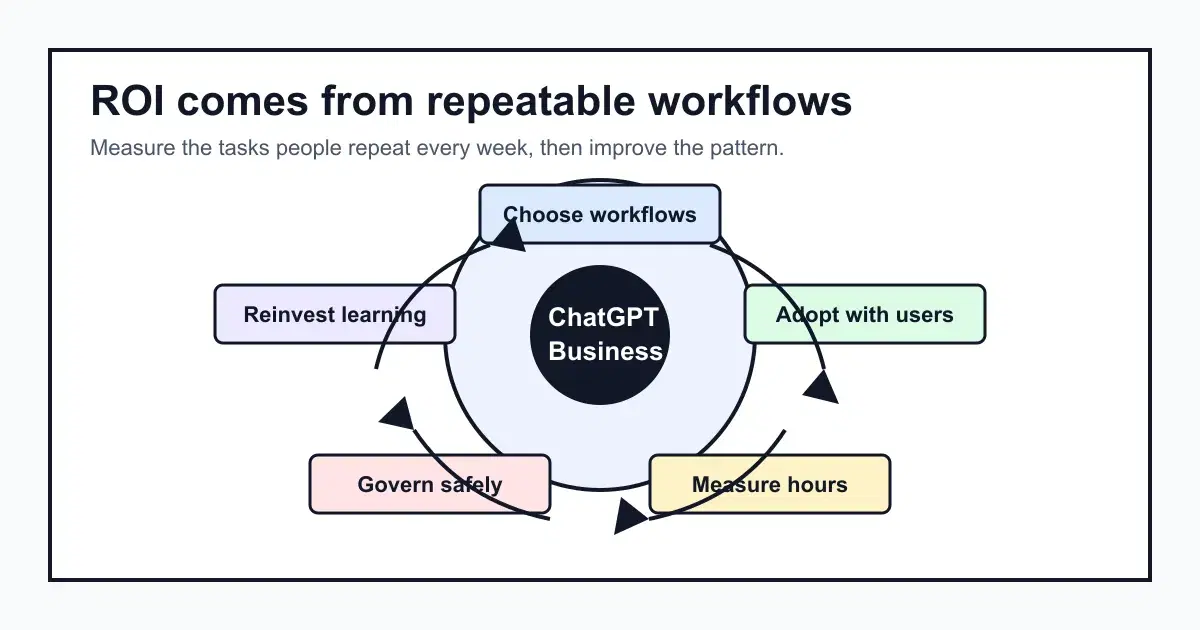
Start with workflows, not seats
Pick five recurring jobs: drafting customer replies, summarising meetings, preparing proposals, analysing spreadsheets, and rewriting policy or training material. Estimate the current time, the assisted time, the number of users, and the weekly frequency. That simple model is usually more honest than a generic AI productivity percentage.
- Hours saved: recurring admin, drafting, research, and review tasks.
- Quality gained: more consistent first drafts, clearer customer communication, and faster internal knowledge sharing.
- Risk reduced: fewer personal-account workarounds and better governance around sensitive prompts.
- Speed gained: less waiting for a specialist when a good first pass is enough to unblock work.
Make the ROI visible
AI Build Group helps SMEs choose early use cases, create starter workflows, and build an adoption rhythm that gives leadership evidence. The goal is not to make every employee an AI expert; it is to move the highest-frequency work into a governed ChatGPT Business workspace and measure whether the change pays back.
If you are building the ROI case now, check ChatGPT Business UK pricing for the current cost drivers, then ask for partner pricing when you are ready for a short rollout conversation. A good buying decision should come with a measurement plan.