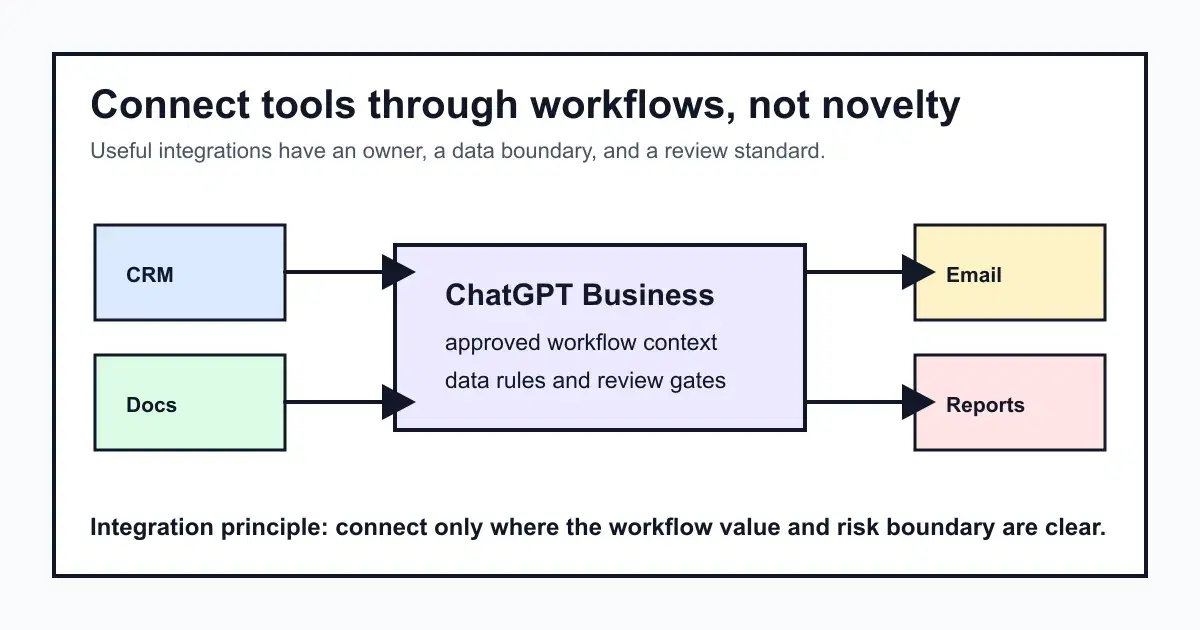
**In brief:** Connecting ChatGPT Business to company tools can bring approved information and actions into useful workflows, but access should follow existing permissions and business ownership. Start with one defined job, a named owner and a review gate. Get ChatGPT Business partner pricing with qualifying setup support from AI Build Group.
Start with the job—not the connection
A long list of connected applications is not a business case. Choose a repeatable task such as preparing a management summary, drafting a customer response from approved records, comparing documents or assembling a project update. Define the input, permitted sources, expected output, human reviewer and success measure before enabling broad access.
What a governed connection needs
- A named business owner for the workflow.
- Permissions inherited from the source system wherever possible.
- A clear boundary for personal, confidential and commercially sensitive information.
- Logging proportionate to the risk and value of the action.
- Human approval before external communication or material decisions.
- A fallback process when information is missing or contradictory.
- Periodic review of access, quality, errors and continued business value.
Useful starting workflows
Next step
Plan a governed ChatGPT Business rollout
Book a call to scope workspace ownership, starter workflows, and governance for your team.
Book a rollout call- Summarise approved project documents into a weekly update.
- Prepare a first draft of a customer response using controlled source material.
- Compare policies or contracts and flag differences for human review.
- Turn meeting notes into actions without exposing unrelated records.
- Generate governed Word, Excel or PowerPoint outputs through OfficeMaker.
- Research an account using internal context alongside current public information.
Experience drawn from real operational systems
Tim Savigar’s background spans application development, infrastructure and business operations. Within Prism’s construction and property-service environment, technology has had to coordinate live projects, employees, contractors, documents and customer reporting. AI Build applies the same practical discipline: permissions, ownership and exception handling matter as much as the demonstration.
How AI Build helps
We begin with workflow discovery, not blanket access. AI Build can help select the first connection, document its data boundary, configure the approved workspace, train users and measure whether it saves time without weakening accountability.
Get ChatGPT Business partner pricing
What you gain from connect ChatGPT Business to company tools
Connect ChatGPT Business to company tools with clear permissions, data boundaries and human review. UK partner pricing and rollout support available.
Book a rollout callRequest your partner offer from AI Build Group. We will confirm eligibility, explain the current buying route and help you plan a controlled first deployment. Get ChatGPT Business partner pricing.