AI workforce transformation should move employees from repeatable information handling towards judgement, relationships, improvement and creation. Artificial intelligence can prepare, search, compare, classify and monitor at scale; people should gain the time, skills and authority to do the work where context, accountability and human connection matter most.
That outcome is not automatic. Buying AI tools can just add another layer of work: more outputs to check, more systems to watch and more uncertainty about responsibility. People move up the value chain only when leaders redesign tasks, roles, controls and measures around the new capability.
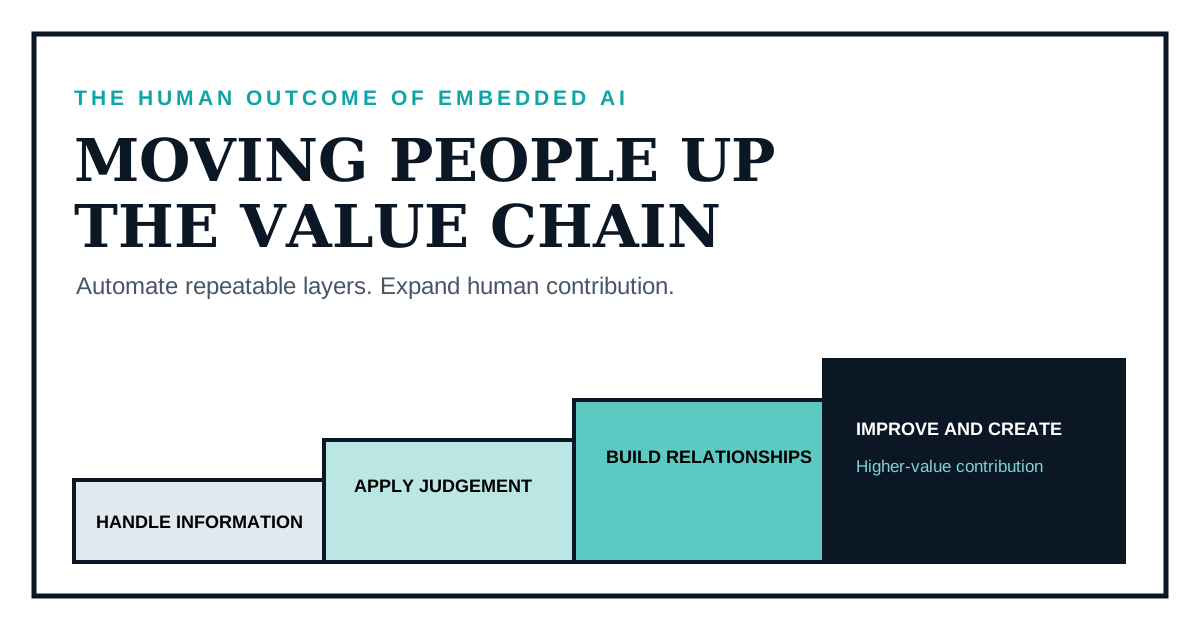
What does moving up the value chain mean?
Moving up the value chain means spending less time on work that is repeatable and easy to specify, and more time on work that benefits from experience, context, creativity, trust or accountable judgement. It is not a statement that administrative work has no value. It is a design principle: scarce human attention should be applied where it changes the outcome most.
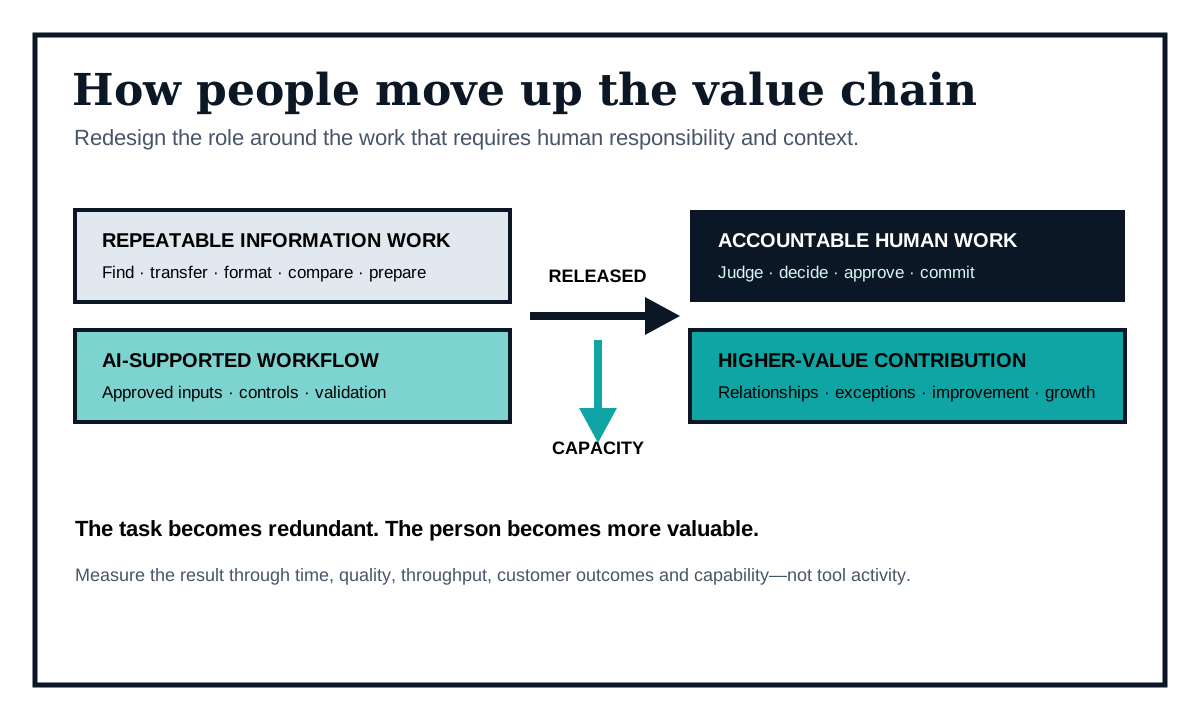
AI changes tasks before it changes jobs
A task is a unit of work. A role is a bundle of tasks plus responsibility, relationships and expected outcomes. A job is the organisational agreement around that role. AI usually enters through individual tasks: summarising a meeting, preparing a report, comparing requirements, drafting a response or monitoring an inbox.
That distinction creates a better workforce conversation. Instead of asking whether an entire job can be automated, ask which tasks AI can perform, which it can assist, which need human approval and which should remain human-led. The new bundle becomes a redesigned role.
What work should AI do, and what should people own?
- AI prepares: search, extract, classify, summarise, compare, draft and monitor.
- People judge: interpret incomplete context, weigh trade-offs, challenge assumptions and accept accountability.
- AI supports consistency: apply approved instructions and surface exceptions.
- People build trust: understand customers, coach colleagues, negotiate and respond to emotion or ambiguity.
- AI reveals patterns: organise evidence and identify signals at scale.
- People improve and create: redesign services, change processes and decide what should happen next.
The boundary depends on consequence, data quality and context. A draft internal summary and an employment decision are not equivalent. Responsible job redesign makes the authority boundary visible and gives people enough evidence to challenge the system.
A practical method for AI job redesign
1. Map the role at task level
List the recurring tasks, their frequency, inputs, outputs, effort, pain points and consequences. Ask employees where work queues, repeats or depends on hidden knowledge. This is not a time-and-motion exercise imposed from above; the people doing the work can see exceptions that a process map misses.
2. Classify the future task
For each task, choose one of four states: human-led, AI-assisted, human-approved automation or bounded automation. Record why. This creates a defensible design and prevents the vague assumption that AI should do everything it technically can.
3. Design the higher-value contribution
Do not wait until time is saved to decide what happens to it. Specify the customer, improvement, quality, coaching or innovation work the employee will take on. Add the required authority and measures. A person cannot move up the value chain if the organisation leaves them in the same role with a faster tool and a bigger workload.
4. Build role-based capability
Generic prompt training is not workforce transformation. Employees need practice with the actual workflow: what the system does, which sources it uses, how to detect a weak answer, what information is permitted, where approval sits and when to escalate. Managers need to coach outcomes rather than reward visible busyness.
5. Measure both workflow and workforce outcomes
Measure cycle time, quality, rework and customer outcomes, but also adoption, confidence, exceptions, role progression and whether released capacity reached the intended higher-value work. A productivity gain that increases stress or hides risk is not mature transformation.
What should leaders say about AI and jobs?
Leaders should avoid two easy promises: that AI will remove everyone, or that it will change no jobs at all. AI directly changes tasks; enough task change can reshape roles, reduce demand in some areas and create demand in others. People deserve an honest view of the direction, the decisions still open and the support available.
The strongest message is accompanied by evidence: employees are involved in workflow design; controls protect customers and staff; training is connected to future roles; and productivity decisions are transparent. Trust comes from the operating choices, not the slogan.
The task becomes redundant; the person moves forward
This principle connects the whole series. What Is an AI-Embedded Company? defines the destination. I Make Myself Redundant Every Week gives it a practical rhythm. Workforce transformation turns the released capacity into stronger roles and better outcomes.
The AI Maturity Assessment establishes where your organisation stands across strategy, skills, process, governance, improvement and transformation. Use it to identify the next capability gap—and the next piece of work that people should no longer have to carry alone.