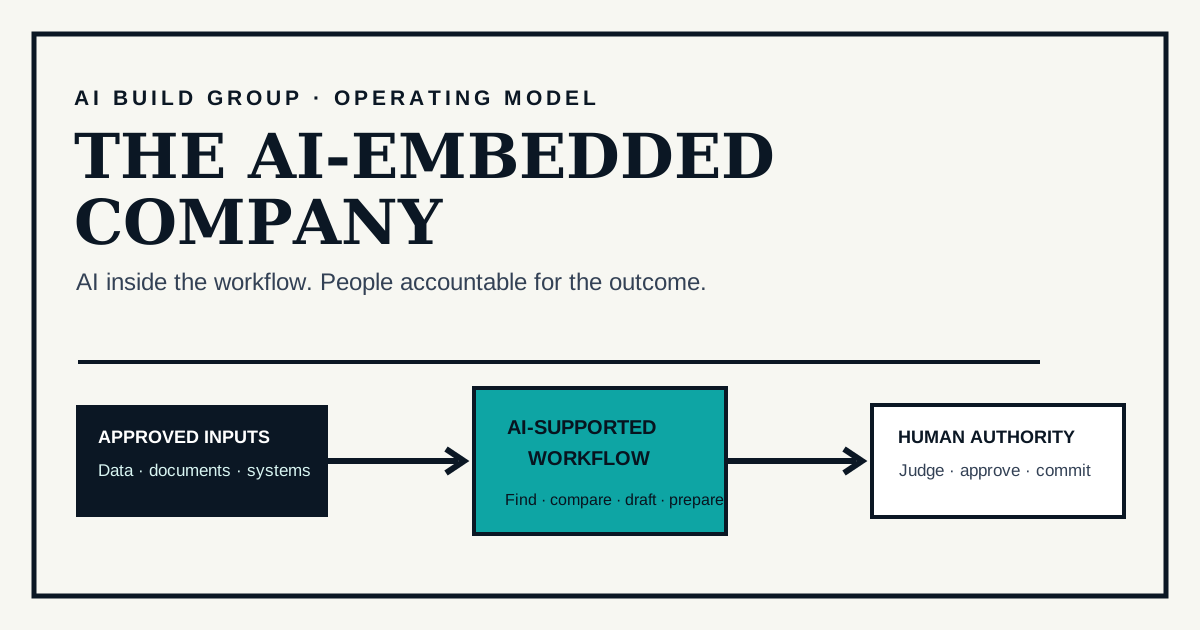
An AI-embedded company is an organisation in which artificial intelligence is built into everyday workflows, decisions and services—not added as a separate tool that people may or may not use. Its AI operating model connects people, processes, data, technology, governance and measurable business outcomes, while humans retain authority for judgement, approval and accountability.
Some organisations call this an AI-native business. We use “AI-embedded company” because most established firms are not starting from scratch. They need to embed AI into the processes, systems and accountabilities they already have, then redesign those elements deliberately as their capability grows.
What makes a company AI-embedded?
The test is not how many AI subscriptions the company owns. The test is whether useful work happens differently. Information is found faster. Routine documents are prepared consistently. Teams receive better decision support. Customer needs are recognised earlier. Controls are designed into the workflow, and leaders can see whether the change has improved speed, quality, cost, risk or growth.
A company can have hundreds of people using generative AI and still have no coherent enterprise AI adoption model. Usage may be fragmented, sensitive information may be handled inconsistently, prompts may be reinvented repeatedly and no one may be measuring the result. That is AI activity, not yet an AI operating model.
How is embedded AI different from simply using AI tools?
- Using AI is individual; embedding AI is organisational.
- Using AI produces one-off outputs; embedding AI creates repeatable workflows.
- Using AI depends on personal prompting; embedding AI captures instructions, context, permissions and quality checks.
- Using AI can hide risk; embedding AI makes ownership, escalation and approval explicit.
- Using AI measures adoption; embedding AI measures business outcomes.
A useful AI-supported workflow has a defined trigger, authorised information sources, clear instructions, an expected output, a named human owner and a way to evaluate quality. It may use an assistant that helps a person, or an agent that performs a bounded sequence of actions. In either case, the workflow—not the novelty of the model—is the unit of transformation.
What are the six capabilities of an AI operating model?
Our AI Maturity Assessment examines six connected capabilities. They prevent an organisation from over-investing in technology while under-investing in the conditions that make the technology useful.
1. Leadership and strategy
Leaders need a shared view of why AI matters, which outcomes have priority and who is accountable. A strategy translates ambition into a portfolio of use cases, investment choices and measures. “Use more AI” is not a strategy; “reduce proposal preparation time while improving consistency and protecting client data” is a useful strategic objective.
2. People and skills
Executives need to make informed investment and risk decisions. Process owners need to redesign work. Domain experts need to express quality standards. Technical teams need to integrate and monitor systems. Employees need the confidence to use AI critically rather than accept every output. Training should therefore be role-based and connected to real work.
3. Process maturity
AI magnifies the process into which it is introduced. If the inputs, ownership and exceptions are unclear, automation can make confusion travel faster. Mature adoption starts by understanding the current workflow, removing unnecessary steps and identifying where AI can assist, prepare, recommend or act.
4. Governance and control
Governance defines what data may be used, which tools are approved, how outputs are checked and when a person must intervene. It should be proportionate to impact. A low-risk internal draft does not need the same control as a decision affecting a customer, employee or regulated obligation. Good governance accelerates adoption because people know the boundaries.
5. Continuous improvement
An embedded workflow is a managed product, not a finished installation. Models, source information and business needs change. Owners need feedback, performance measures, version control and a regular review rhythm. Weak outputs become evidence for improvement rather than a reason to abandon the programme.
6. Business transformation
The final capability is the organisation’s ability to convert local gains into a different way of operating. That can mean new services, shorter cycle times, better customer experiences, new commercial models or greater capacity without matching growth in overhead. Transformation appears when multiple improved workflows reinforce one another.
Where should human judgement remain?
An AI-embedded company is not a company without people. It is a company that is explicit about the work machines should do and the authority people must retain. AI is well suited to searching, classifying, summarising, drafting, comparing and monitoring. People remain essential where context is incomplete, consequences are material, values conflict, relationships matter or accountability cannot be delegated.
A practical design question is: what must a responsible person be able to see, challenge, approve or stop? Human approval should not be a ceremonial click at the end; the person needs the context and time to exercise real judgement.
How do you become an AI-embedded company?
- Assess the current state across strategy, people, process, governance, improvement and transformation.
- Choose a small number of valuable workflows with clear owners and measurable outcomes.
- Map each workflow before selecting the technology.
- Design data access, controls, human authority and exception handling from the start.
- Build and test with the people who perform and own the work.
- Measure business results, capture learning and expand what works.
- Reassess maturity regularly so capability grows in balance.
The first 90 days should create evidence, not theatre. For external governance context, see the [NIST AI Risk Management Framework](https://www.nist.gov/itl/ai-risk-management-framework) and the [ICO guidance on AI and data protection](https://ico.org.uk/for-organisations/uk-gdpr-guidance-and-resources/artificial-intelligence/). These are third-party frameworks, not independently validated evidence of AI Build project outcomes. One well-owned workflow that saves time, improves quality and is trusted by its users is more valuable than a crowded catalogue of disconnected pilots. The evidence from that workflow then improves the next one.
What does AI maturity have to do with it?
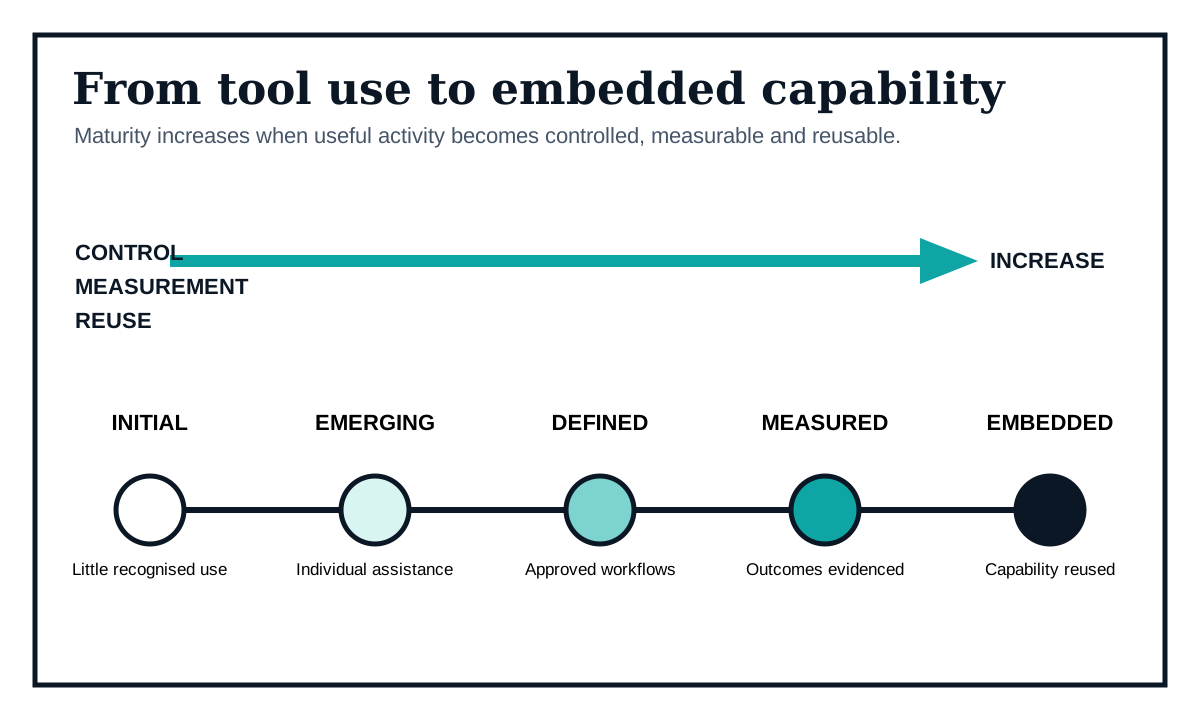
AI maturity is the organisation’s ability to achieve repeatable, governed and improving outcomes from AI. It provides the route from experimentation to an embedded operating model. Our AI Maturity Assessment evaluates the six capabilities above and turns the findings into a prioritised roadmap rather than a generic score.
The AI-embedded company is built one workflow at a time
The destination is organisational, but progress is concrete. Next, I Make Myself Redundant Every Week explains the weekly habit I use to turn recurring work into reliable AI-supported workflows. The final article, How AI Moves Employees Up the Value Chain, explores what that redesign means for people, roles and higher-value work.