How much is ChatGPT Business in the UK?
The published ChatGPT Business price for standard seats is $25 per user per month on monthly billing, or $20 per user per month when you pay annually. Every workspace needs at least two standard seats. OpenAI states the list price in USD; a UK card will usually convert and then add VAT, unless you buy through a UK partner who can invoice in GBP. Pricing checked 24 August 2026 from OpenAI Help (What is ChatGPT Business?) and OpenAI’s Business pricing page — verify those sources before a purchase order is raised, because regional currency and promotions can change the invoice.
- Monthly: $25 per user per month (OpenAI list, USD — checked 24 August 2026)
- Annual: $20 per user per month, billed annually (OpenAI list, USD)
- Minimum: 2 standard ChatGPT Business seats
- UK extra: currency conversion + VAT at checkout, unless invoiced in GBP through a partner
- Primary source: OpenAI Help and openai.com/business/pricing
Is ChatGPT Business billed monthly or annually, and what is the minimum seats rule?
You can pay monthly at $25 per seat or commit annually at $20 per seat per month. The annual plan is the cheaper list rate; the monthly plan is the one to use while a pilot is still proving itself. The 2-seat minimum applies to every standard ChatGPT Business workspace — a one-person Plus subscription cannot be “upgraded” into Business without a second seat. Usage-based Codex-only seats are a different product and are not available to new Business workspaces after 24 June 2026.
- Monthly billing: $25 per seat per month, no annual lock-in
- Annual billing: $20 per seat per month, billed up front for the year
- 2-seat minimum on every standard Business workspace
- New workspaces cannot add a first Codex-only seat after 24 June 2026
How does ChatGPT Business pricing compare with Plus, Pro and Enterprise?
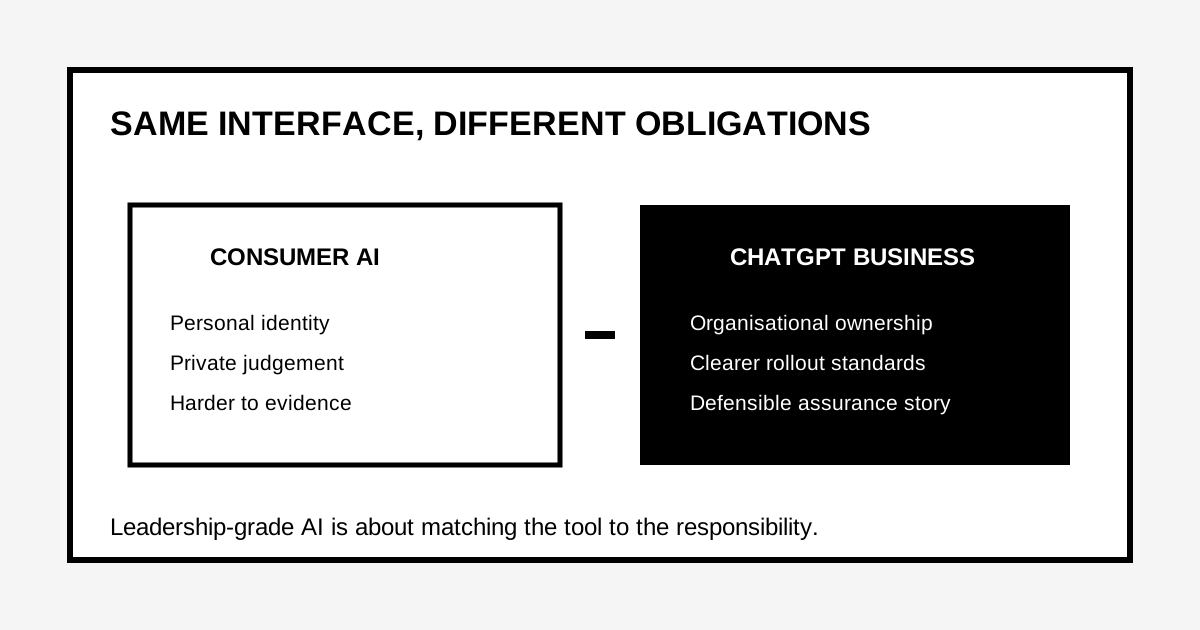
ChatGPT Plus is a personal subscription at about $20 per month with consumer terms and no organisation admin. ChatGPT Business is the team plan: central billing, admin controls, and business data protections, from $20–25 per seat with a 2-seat minimum. ChatGPT Enterprise has no public list price — it is quote-only — and is the route when you need SCIM, exportable audit logs, custom retention or a formal SLA. OpenAI has also announced Premium Business seats (higher published rates, currently waitlist) for heavier usage inside the same workspace; those are not the standard UK “ChatGPT Business cost” figure. See the plan comparison table above and the full Business vs Enterprise decision page for SSO, SCIM and procurement.
- Plus: personal plan, no admin, consumer data terms
- Business: $20–25 per seat, 2-seat minimum, SAML SSO, central billing
- Enterprise: quote only — SCIM, audit export, custom retention, SLA
- Premium Business seats: higher published rate, waitlist — not the standard list price
What is included in a ChatGPT Business seat, and what does AI Build add?
A standard ChatGPT Business seat includes ChatGPT and Codex access, GPTs, Projects, Apps, Company Knowledge, and baseline Agent, Deep Research and voice/image usage, with optional workspace credits if you exceed per-seat limits. The product is the same whether you buy direct from OpenAI or through AI Build Group. The partner route adds eligibility for a genuine OpenAI SMB Channel Partner discount code, two hours of complimentary remote setup on qualifying UK and Ireland purchases, and optional governance or adoption consulting. That is not a generic internet coupon: codes are issued after an eligibility check. Current partner-offer availability is confirmed on the get-offer page, not guessed from promo-code round-ups.
- Included: ChatGPT + Codex in one workspace, admin, central billing, business data protections
- Optional: pooled workspace credits beyond per-seat feature limits
- AI Build partner: discount code where eligible, two hours of setup, rollout support
- Not included: a public “ChatGPT promo code” scraped from coupon sites
Do UK buyers pay in GBP, and is VAT added?
OpenAI’s published Business list price is in US dollars. Direct OpenAI checkout for a UK organisation typically converts to the card’s currency and adds VAT. A UK OpenAI SMB Channel Partner may quote or invoice in GBP, which is often easier for finance, but the underlying list rate is still the OpenAI USD figure. Do not treat an unofficial GBP “ChatGPT price UK” blog as the source of truth — convert from the dated USD list price, then add VAT, unless you have a partner quote in writing.
- List price: USD $25 monthly / $20 annual per seat
- UK checkout: conversion + VAT (standard rate currently 20%)
- Partner quotes: may be issued in GBP; still reconcilable to OpenAI list
- Always check the amount shown on the OpenAI invoice or partner proposal
What does ChatGPT Business total cost of ownership include?
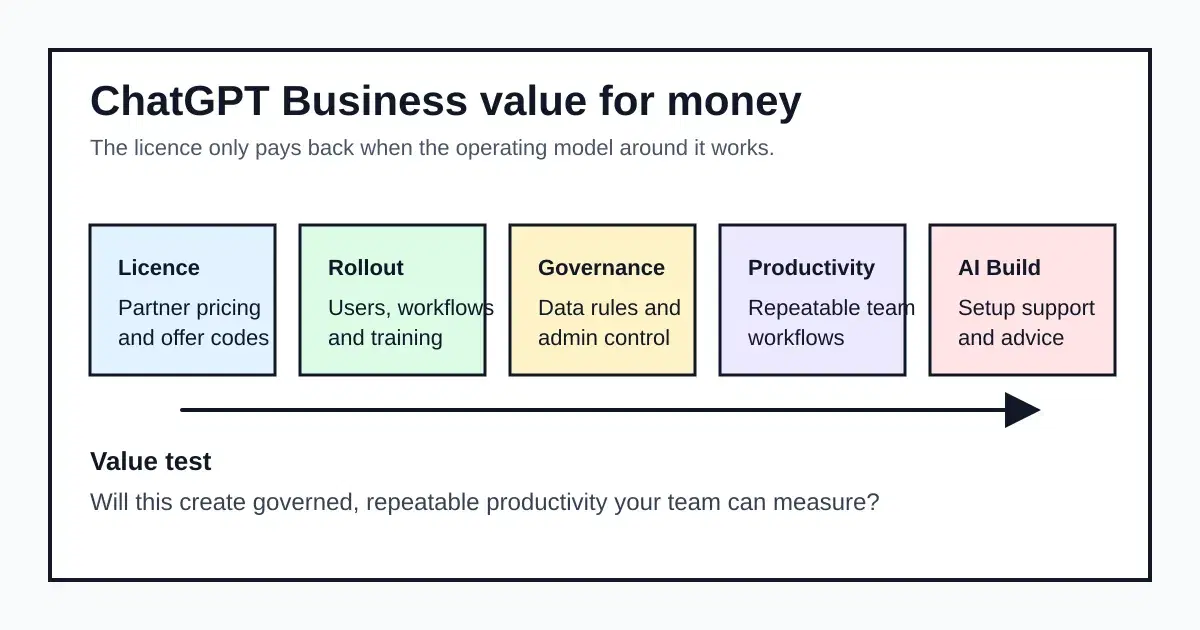
The subscription line is only part of the real cost. A credible TCO figure adds onboarding effort, an AI use policy, workflow design for pilot use cases, optional workspace credits if usage exceeds per-seat limits on advanced features, and time spent training pilot users — most of which lands in weeks two to six of rollout, not on the invoice itself. See the hidden costs section below before you finalise a business case.
- Per-seat subscription cost
- Onboarding and workspace configuration
- Governance and AI use policy work
- Workflow design and pilot training time
- Optional workspace credits for usage beyond per-seat feature limits
What does ChatGPT Business cost for a 5, 10, 25, or 50-seat team?
Team-size cost scales linearly with seats, since ChatGPT Business list pricing has no volume discount tier below Enterprise — five seats costs five times the per-seat rate, fifty seats costs fifty times. The ladder below uses OpenAI's published $25 monthly / $20 annual list price per seat (2026 figures; verify on OpenAI Help), so you can sanity-check any partner quote against list price before a discount code is applied.
How does ChatGPT Business partner free-seat pricing work?
Partner free-seat pilots reduce your effective per-seat cost during the first commitment period rather than changing OpenAI's published list price. If a qualifying UK or Ireland order includes complimentary pilot seats alongside paid seats, divide the total contract cost by the full seat count — paid plus free — to get the blended rate finance should see. A 10-seat order with two complimentary pilot seats, for example, blends the paid-seat cost across all 10 users instead of the 8 seats actually invoiced, which is the number that belongs in the business case rather than the sticker price of the paid seats alone.
How does ChatGPT Business pricing compare to Microsoft 365 Copilot's true cost?
Microsoft 365 Copilot's headline add-on price is not the number that lands on your budget. Copilot's business-tier add-on (for organisations under roughly 300 seats) commonly lists at around $21 per user per month on an annual commitment, while Copilot's enterprise-tier add-on lists at $30 per user per month — but both require an eligible Microsoft 365 base licence underneath, typically Business Standard, Business Premium, E3, or E5. Once you stack the required base plan on top of the add-on, the realistic all-in cost commonly lands between roughly $34 and $90 per user per month depending on your existing Microsoft 365 tier — verify current Microsoft pricing before comparing, since these figures move and vary by region. ChatGPT Business, by contrast, is a standalone $20–25 per seat per month subscription with no required base licence, which usually favours ChatGPT Business on a true-cost basis for teams that do not already need the underlying Microsoft 365 upgrade for other reasons. See our full plan comparison for the wider Enterprise decision.
- ChatGPT Business: roughly $20–25 per seat per month, no base licence required
- Copilot business-tier add-on: roughly $21 per seat per month plus a required M365 Business Standard/Premium base licence
- Copilot enterprise-tier add-on: $30 per seat per month plus a required M365 E3/E5 base licence
- All-in Copilot cost typically lands around $34–90 per seat per month once the base licence is included
What ROI formula justifies ChatGPT Business pricing to finance?
A defensible ROI formula is: (hours saved per seat per week × hourly cost × seat count × 52) minus (annual licence cost plus rollout cost) equals net annual value. The hours-saved figure is the part most business cases get wrong by guessing — use a conservative, function-specific benchmark instead of a blanket productivity claim. McKinsey's research on generative AI's economic potential documented a controlled study of 5,000 customer service agents in which generative AI assistance increased issue resolution by 14 percent per agent-hour and cut average handling time by 9 percent — a specific, sourced figure finance can interrogate, unlike a generic 'saves everyone an hour a day' assumption. Run the same formula against your own pilot data once you have two to four weeks of usage, and replace the McKinsey benchmark with your measured number as soon as you have one.
- Hours saved per seat per week × hourly cost × seats × 52 = gross annual value
- Gross annual value minus annual licence and rollout cost = net annual value
- Cited benchmark: 14% faster issue resolution, 9% shorter handling time (McKinsey generative AI productivity research)
- Replace the benchmark with your own pilot data once you have real usage to measure
What hidden costs sit behind ChatGPT Business pricing?
The per-seat subscription line is the smallest part of most ChatGPT Business budgets once three items are properly scoped. First, workspace credits: standard seats include per-seat limits on advanced features such as Deep Research, Agent, Voice, and image generation, and a workspace owner can optionally purchase pooled credit packs to unblock users who exceed those limits — budget for this if your pilot workflows lean on advanced tools. Second, Codex: standard seats include baseline ChatGPT and Codex access, but usage-based Codex seats with their own credit requirements are no longer available to new Business workspaces, or to workspaces that never added one before 24 June 2026 — if a proposal still assumes standalone Codex seat economics, confirm that against current OpenAI Help articles before it goes into a budget. Third, governance time: policy work, review gates, and pilot training rarely appear on an invoice but reliably consume real hours in weeks two to six of rollout.
- Workspace credits — optional, pooled, for usage beyond per-seat feature limits
- Codex seat changes — usage-based Codex seats closed to new workspaces from 24 June 2026
- Governance and policy time — rarely invoiced, always real
- Pilot training hours — the cost most business cases forget to scope