During a vendor security review, an analyst finds customer identifiers in an AI conversation thread. Nobody approved the workflow. Everyone assumed “people know not to.” The risk was not malware; it was convenience running through unmanaged identities.
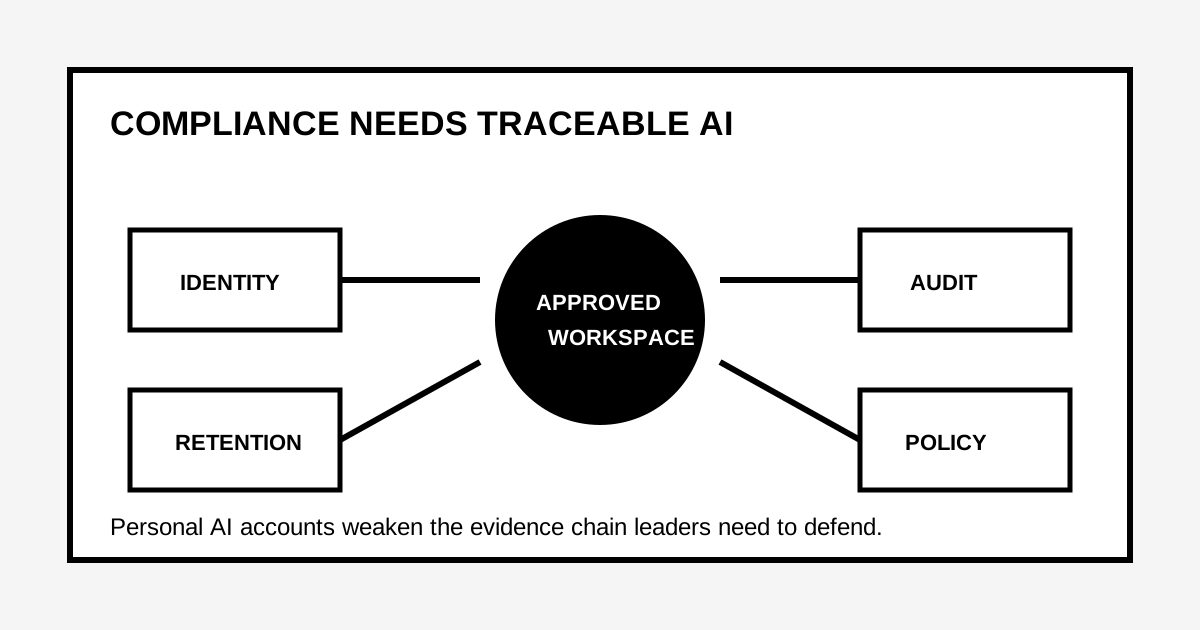
Start from part one: shadow AI is already operating inside your business—this instalment isolates compliance and identity fractures; part three explains why heavy-handed bans widen exactly the gaps described below.
Personal accounts are shadow IT with better marketing
Security teams spent a decade wrestling unsanctioned SaaS. AI assistants arrived dressed as productivity miracles—so adoption skipped the uncomfortable procurement conversation entirely. The result is predictable: sensitive fragments migrate into environments where joiners-movers-leavers logic, conditional access, and corporate retention assumptions simply do not apply the same way.
If you serve owners worried about fines and headlines, IT leaders accountable for identity architecture, or security stakeholders drafting defensible controls—start here: unmanaged AI identities are not minor exceptions; they are systemic drift.
Shadow AI compliance is ultimately an honesty problem disguised as a tooling problem. Almost everyone intellectually agrees sensitive data should stay controlled; the trouble is that “controlled” was architected for files and endpoints while prompts behave like thoughts typed into a box that feels harmless. That mismatch is where regulators stop giving partial credit.
Here is the executive point worth stating plainly: personal accounts convert collective responsibility into private gambling. Each employee becomes their own mini procurement officer, mini legal reviewer, and mini security architect—usually at 5pm on a Friday. That is not a scalable operating model for any organisation serious about assurance.
Structured breakdown: where personal AI breaks your model
What you gain from shadow AI compliance risks
Explore the updated insights and solutions regarding shadow AI security compliance risks, ensuring your business is protected against unauthorized AI usage.
Claim your free seat- Identity fragmentation: consumer logins sit outside your IdP, weakening lifecycle controls for staff and contractors alike.
- DLP blind spots: prompts rarely inherit the classification discipline you enforce on documents and email.
- Retention mismatch: legal hold and records policies assume enterprise repositories—not scattered threads tied to individual subscriptions.
- Third-party risk opacity: tools never assessed still influence decisions touching regulated data categories.
- Forensics friction: investigations require reconstructing usage across personal billing boundaries and opaque exports.
Notice the pattern: each failure mode attacks something enterprises spent years building—single identity, consistent retention, supplier diligence, and investigative coherence. Shadow AI compliance is dangerous precisely because it corrodes mature controls without triggering traditional alerts. Nothing “looks hacked”; everything slowly becomes unprovable.
For IT leaders, the operational implication is blunt: if AI sits outside IdP lifecycle processes, your joiners-movers-leavers programme has a hole you cannot patch with polite reminders. Accounts persist; conversations linger; access patterns diverge; contractors rotate while threads remain.
Security, compliance, and data leakage—tied together
These issues compound. A single careless paste might not sink you—but systematic ungoverned usage shapes exposure distributions in ways insurers and regulators increasingly model explicitly. Shadow AI compliance is not “maybe someday”; it shows up in questionnaires today and in incident timelines tomorrow.
Data leakage via prompting is insidious because it feels informal—until customer trust or regulatory patience breaks.
Security leaders should treat prompting like any other egress path: not because every prompt is sensitive, but because systematic usage guarantees eventual boundary crossings under stress. Compliance leaders should treat unmanaged threads like unmanaged repositories—except repositories were easier to inventory.
Owners should internalise the reputational asymmetry: proving diligence after an incident is expensive; proving diligence proactively is merely inconvenient. Shadow AI compliance failures rarely announce themselves politely—they arrive as external scrutiny at the worst possible moment.
- Cross-border processing assumptions may no longer match where conversational data effectively lives.
- Sector-specific duties (health, finance, critical infrastructure) amplify consequences when supervision cannot be evidenced.
- Supply-chain assurance fails when downstream partners cannot explain AI touchpoints in workflows.
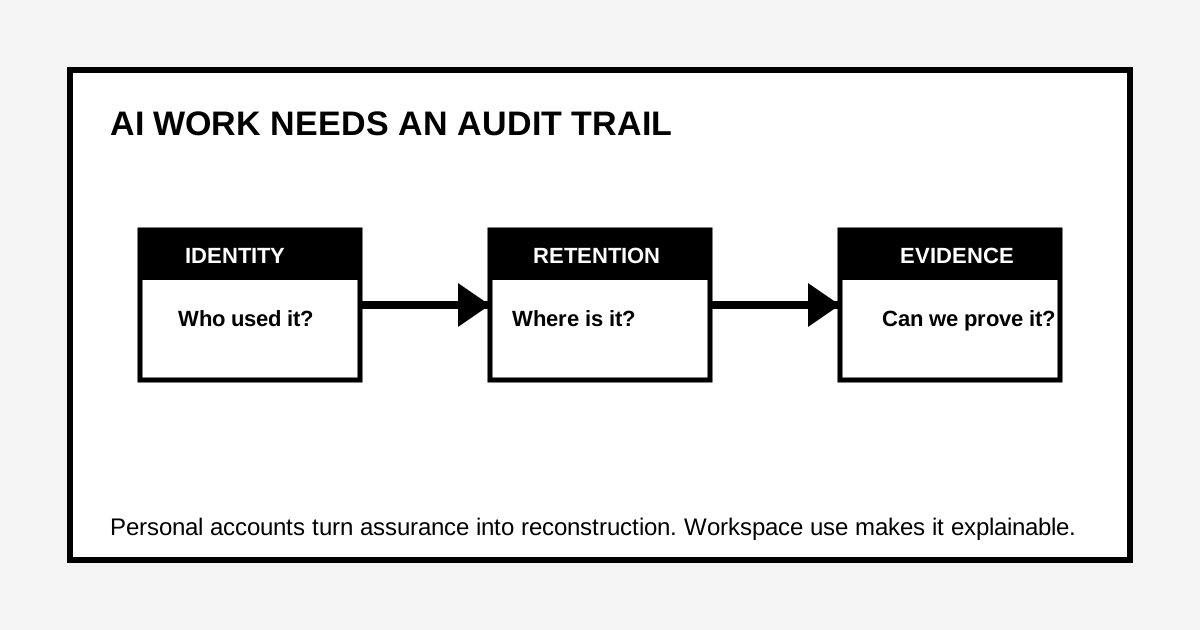
When you combine these threads, the uncomfortable conclusion is simple: shadow AI compliance is not a niche infosec topic—it is a core enterprise architecture issue. If your architecture cannot answer basic questions about AI-assisted work, your assurance story is hollow no matter how polished the brochure.
Why action cannot wait for “the perfect policy workshop”
What you gain from shadow AI compliance risks
Explore the updated insights and solutions regarding shadow AI security compliance risks, ensuring your business is protected against unauthorized AI usage.
Claim your free seatUsage curves are steep; policy calendars are flat. Every month of delay widens the delta between stated controls and lived behaviour—exactly the gap adversarial auditors and plaintiffs love. Meanwhile, competitors standardise on organisational offerings while you debate slides.
The uncomfortable truth: your organisation already made a deployment decision via behaviour. The only choice left is whether leadership owns it—or discovers it under stress.
Workshops have their place. But workshops do not stop prompts. Only standards plus tooling plus sponsorship does—and sponsorship means executives visibly choosing an organisational path rather than outsourcing discomfort to middle management.
There is also a sequencing trap: teams assume they must “finish policy” before deploying. In reality, partial clarity with a governed workspace beats perfect ambiguity with shadow tabs. Shadow AI compliance improves fastest when people have somewhere legitimate to go.
ChatGPT Business: align AI with how you already prove trust
ChatGPT Business is the pragmatic correction: bring AI into an organisational posture where administration, rollout, and stakeholder conversations resemble serious enterprise software—not a thousand solo experiments billed to personal cards.
AI Build Group supports UK organisations as an OpenAI SMB Channel Partner—bridging technical rollout with the narrative security and compliance teams need to sign with confidence.
ChatGPT Business is not a magical shield; it is an organisational container—something your stakeholders recognise from mature SaaS adoption. Containers do not eliminate misuse; they make misuse harder to rationalise as “everyone does it,” and easier to correct with training, monitoring patterns, and executive modelling.
If you want a provocative closing argument for the board: unmanaged AI identities are the fastest way to turn good employees into accidental insiders—without malice, without drama, and without the forensic clarity you expect when something goes wrong.
Close the gap—deliberately
What you gain from shadow AI compliance risks
Explore the updated insights and solutions regarding shadow AI security compliance risks, ensuring your business is protected against unauthorized AI usage.
Claim your free seatStop treating personal AI accounts as benign shortcuts. Replace shadow pathways with a governed workspace and recover the visibility your programme promises on paper.
Request ChatGPT Business partner pricing and your offer code from AI Build Group—make AI assistance auditable before your next renewal conversation makes it mandatory.
Begin with a thirty-day executive commitment: name an approved workspace, publish explicit prohibited examples tied to real data classes, and measure whether shadow logins decline. Shadow AI compliance improves when leadership stops debating whether the risk exists—and starts routing demand responsibly.