An engineering manager gets a blunt mandate: “No AI tools.” Within days, contractors still refactor snippets through consumer assistants. They just stop mentioning it in stand-ups. Leadership gets paper compliance while real visibility disappears.
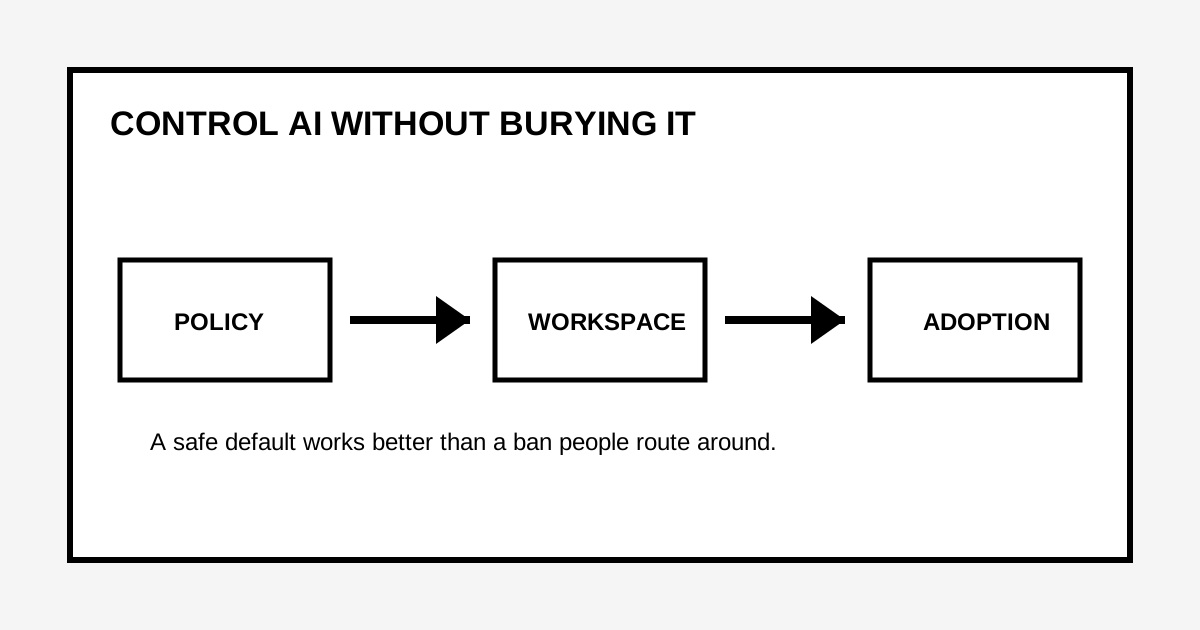
This series treats shadow AI from three angles: recognising adoption you never sanctioned, tracing compliance exposure through personal accounts, and here—the governance mistake of substituting prohibition for an approved workspace. The canonical service page is AI governance consulting, with ChatGPT Business governance as the product-specific support page.
The ban fantasy: policy without physics
Directors like crisp narratives: “We banned it.” Markets and regulators like evidence: “Show me how work happens.” Those two urges collide when your highest performers optimise throughput regardless of memos. If your answer to demand is prohibition without substitution, you are not controlling AI—you are outsourcing oversight to individual judgement at 11pm on a laptop.
This piece speaks to owners balancing innovation and duty, IT leaders responsible for workable standards, and security professionals who know realistic beats heroic when cultures are already addicted to speed.
Let’s be provocative on purpose: a ban without substitution is not governance—it is denial with HR letterhead. Controlled AI adoption is the adult alternative. It admits demand, defines rails, and backs standards with tooling people will actually use. Anything less is a polite fiction—and polite fictions fail the moment someone asks for receipts.
If your organisation markets itself as innovative, your internal AI posture cannot simultaneously behave like a Victorian boarding school. Employees notice the contradiction faster than executives admit it. When they do, they route around you—not because they are reckless, but because their incentives reward shipping.
What breaks when “no” becomes your only strategy
- Usage moves underground—outside SSO, procurement visibility, and consistent training.
- Credibility erodes: employees stop raising honest questions because honesty invites friction.
- Legal lacks an approved surface to attach retention, acceptable-use nuance, and vendor diligence.
- High performers improvise anyway—creating uneven quality and uneven risk across teams.
- Executives inherit false confidence: silence is mistaken for absence.
Each bullet is a failure mode you can observe without fancy telemetry: inconsistent outputs across teams, uneven security hygiene, secret toolchains that vary by department, and legal reviews that cannot attach to any approved platform. Controlled AI adoption fixes this by shrinking the solution space: fewer rogue paths, clearer standards, faster enablement.
There is also an ownership issue. When AI is banned officially but used unofficially, nobody credible owns the risk. Security cannot defend what it cannot see; IT cannot support what it cannot provision; legal cannot contract what procurement never bought. The ban creates a responsibility vacuum—and vacuums get filled by individuals making private judgement calls at scale.
Compliance loves clarity; bans supply fog
Partner offer
Request your ChatGPT Business discount code
UK OpenAI SMB Channel Partner pricing with complimentary setup on qualifying purchases.
Get partner pricingWhen AI sits in shadow channels, your compliance story becomes a patchwork of hypotheticals. Auditors do not reward theatrical toughness—they reward traceability. Fragmented consumer accounts multiply contractual ambiguity: whose terms govern which conversation? Where does data reside? What happens on departure?
Data leakage risk spikes when there is no sanctioned alternative because people still solve problems the fastest way they know how—often by pasting context they should isolate.
Your compliance peers are not trying to slow you down for sport. They are trying to prevent the organisation from promising controls it cannot operationalise. Bans feel like control because they produce paperwork. In practice, they often produce the opposite: the appearance of control without the mechanisms that make control measurable—identity, administration, training tied to a real platform, and vendor diligence you can reference under pressure.
From a data-protection perspective, “we told people not to” is not a technical safeguard. It is a hope. Hopes are not appendices customers accept in DPAs.
- Shadow sprawl increases third-party risk surface faster than quarterly reviews can absorb.
- Incident investigations stall without authoritative logs tied to organisational identities.
- Insurance narratives weaken when controls cannot be demonstrated at the point of work.
If you want a crisp executive test: ask your CISO whether they would rather investigate an incident inside an organisational workspace or across a dozen consumer identities. The answer tells you whether bans are protecting the firm—or protecting egos.
Why urgency is climbing—not fading
Boards are asking sharper questions. Customers embed AI clauses into contracts. Competitors advertise productivity gains you cannot honestly deny exist inside your walls—because they do. The longer you pretend bans equal control, the wider the gap grows between official posture and operational truth.
The competitive penalty is not merely reputational; it is operational. Teams forced into secrecy adopt inconsistently, reinvent prompts badly, and fragment institutional knowledge.
There is a calendar reality too: every planning cycle, someone will ask for an “AI strategy.” If your strategy still assumes future adoption, you are already late. Controlled AI adoption is how you compress calendar lag: you align tooling with behaviour before the next renewal forces an embarrassing confession.
Finally, customers are learning to ask smarter questions. “Do you use AI?” is being replaced by “how do you supervise AI-assisted work?” If your internal answer depends on everyone behaving nicely, you will sound naive to sophisticated buyers.
ChatGPT Business: control without pretending demand vanished
ChatGPT Business gives organisations a credible yes: fast assistance with administrative scaffolding closer to how you already manage SaaS—rather than an endless game of whack-a-mole with consumer tabs.
AI Build Group helps UK businesses channel that demand responsibly—translating vendor capability into rollout patterns stakeholders can sign without holding innovation hostage.
ChatGPT Business is not a philosophical statement; it is an operational instrument. It lets leadership say something rare and valuable in enterprise transitions: we standardised on a serious platform, we trained against realistic misuse, and we can explain how work happens. That sentence is worth more than ten policy decks nobody reads.
If you fear “another subscription,” reframe the cost: you are buying coherence—fewer shadow tools, fewer emergency meetings, fewer incidents born from improvisation. In many organisations, that coherence pays for itself faster than spreadsheets admit.
Executive decision: substitute, don’t suppress
What you gain from controlled AI adoption
Banning AI pushes use underground. Give teams approved workspaces, red lines and governance support so adoption becomes visible, safe and useful for UK leaders.
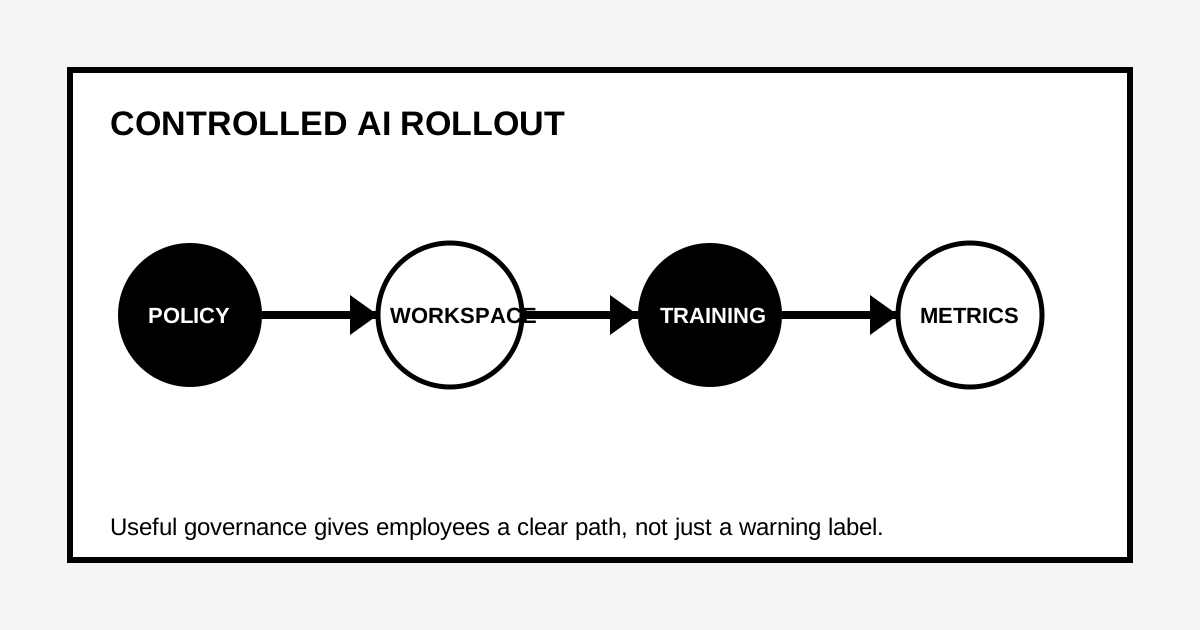
Claim your free seatReplace prohibition with a governed workspace. Publish red lines that matter, train against realistic misuse, and measure adoption honestly. Then defend your programme with receipts—not hopes.
Get partner pricing and your ChatGPT Business offer code through AI Build Group and move from underground chaos to an accountable standard your CIO, CISO, and COO can stand behind together.
Close with discipline: publish three red lines everyone understands (examples beat slogans), assign an executive sponsor who will defend the trade-offs publicly, and measure adoption monthly—not annually. Controlled AI adoption is a leadership behaviour as much as a technical rollout.