A CIO sees zero sanctioned AI spend while internal surveys show most departments use assistants weekly. The board does not ask who owns the pilot. It asks who owns the risk. If ownership is unclear, start with AI governance consulting rather than another isolated tool review.
Why traditional IT approvals choke on generative AI
Software governance assumed discrete apps with owners and boundaries. Generative AI behaves like electricity: it touches drafting, analytics, code, HR comms, and customer success simultaneously. If your process optimises for monthly CAB theatre while teams iterate daily, you do not get safety—you get circumvention.
This playbook framing targets IT leaders charged with enabling innovation without becoming the organizational bottleneck—plus security peers who need controls that survive contact with real workflows.
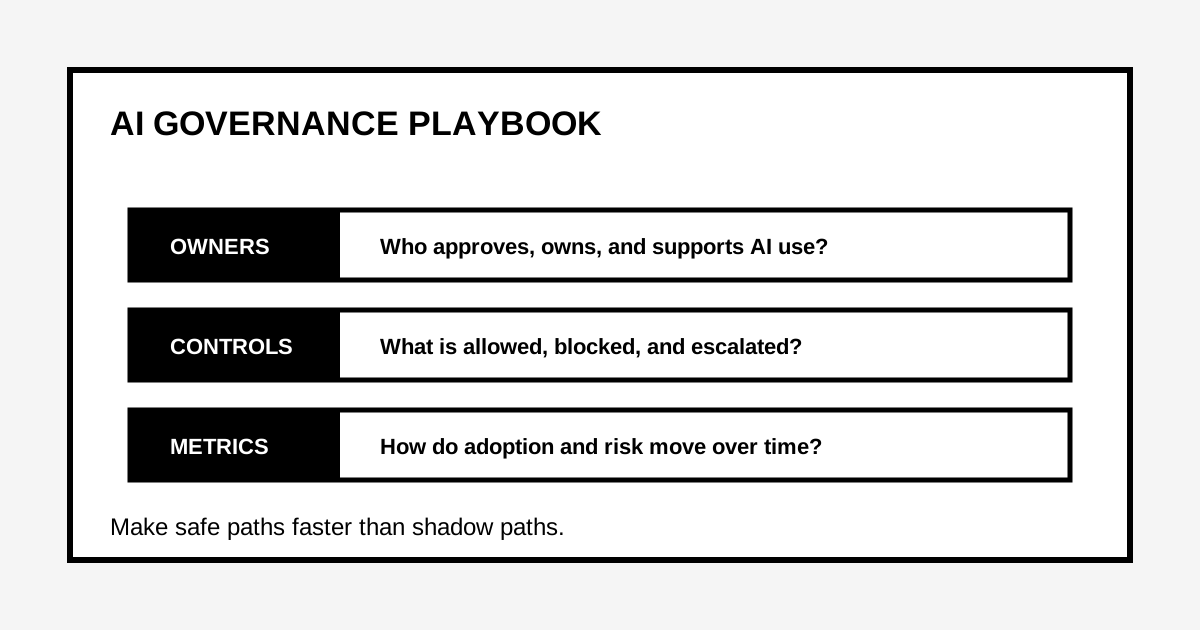
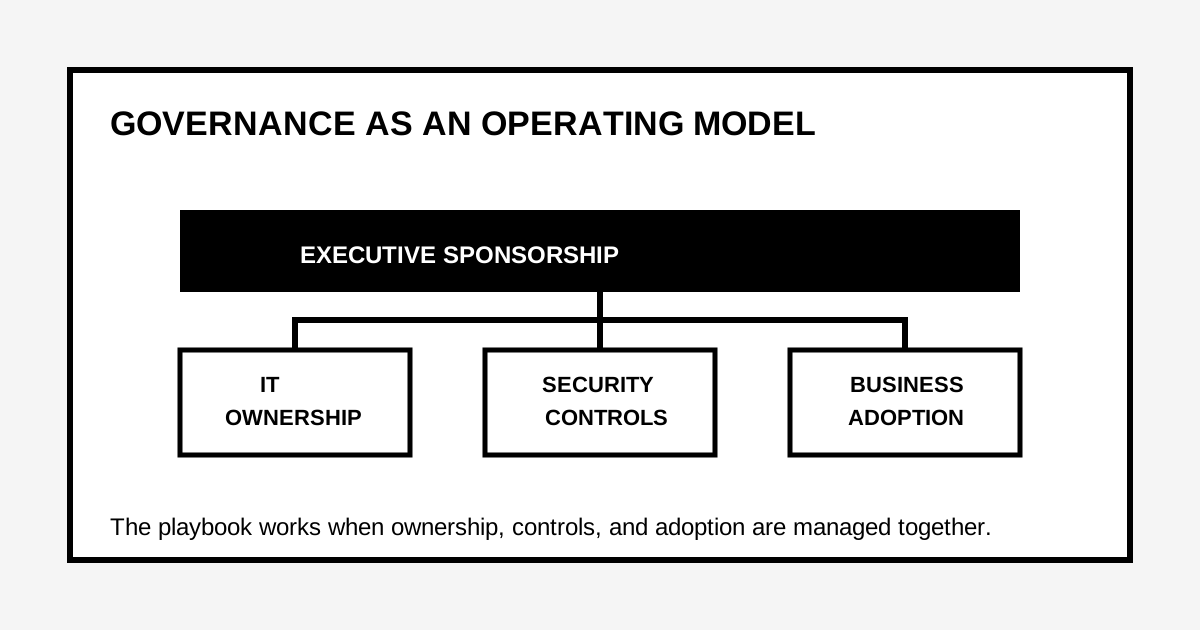
Governance is not a morale lecture; it is operating discipline. The AI governance playbook that works in 2026 looks less like a binder and more like infrastructure: a standard workspace, measurable adoption, explicit red lines, and executive sponsorship that survives the first disagreement between speed and safety.
If you want a slightly provocative truth for your peers: IT does not “win” AI by controlling every prompt; IT wins AI by making safe paths faster than unsafe ones. That is not permissiveness—it is engineering reality.
Diagnose the failure modes—honestly
- Parallel experiments produce inconsistent guardrails and duplicated prompt lore across teams.
- Without executive sponsorship, IT becomes synonymous with “no,” accelerating shadow adoption.
- Metrics track licences purchased, not assisted hours—so dependence is systematically underestimated.
- Vendor sprawl grows quietly via expenses and trials, weakening procurement leverage and integration clarity.
- Documentation debt accumulates because nobody owns end-to-end AI workflow maps—until auditors ask.
Most IT organisations already recognise these failure modes individually; the governance gap is whether leadership treats them as isolated annoyances or as systemic signals. When experiments multiply without a standard, you do not get healthy innovation—you get roulette: some teams brilliant, some teams reckless, and nobody able to explain the distribution.
There is also a political failure mode: IT becomes the villain because it is the easiest department to blame for saying “slow down.” The playbook fix is to pair every constraint with a sponsored fast path—otherwise constraints simply relocate behaviour into shadow stacks.
Risk translation for security and compliance stakeholders
Partner offer
Request your ChatGPT Business discount code
UK OpenAI SMB Channel Partner pricing with complimentary setup on qualifying purchases.
Get partner pricingInconsistent governance cultivates inconsistent behaviour—the worst of both worlds for risk teams. Some teams train rigorously; others improvise dangerously. Some isolate sensitive context; others paste freely. Your policy stack cannot compensate for cultural randomness at scale.
Data leakage and weak supervision narratives travel together: once regulators doubt your ability to evidence controls, scrutiny expands.
Translate this for executives without jargon: inconsistent governance produces inconsistent behaviour at scale—and inconsistent behaviour is what audits feast on. Not because auditors enjoy pain, but because uneven practice makes incidents predictable statistically.
Security stakeholders deserve more than policy promises; they deserve an environment where identity and administration resemble the rest of the stack. Compliance stakeholders deserve artefacts: onboarding records, acceptable-use examples tied to real roles, and an approved platform name they can write into questionnaires without blushing.
- Training variance creates pockets of unsafe prompting culture resistant to one-off town halls.
- Audit trails fragment across consumer identities and unsanctioned tools.
- Incident timelines lengthen when ownership of AI steps is unclear inside workflows.
If you want a crisp governance KPI that executives actually understand: time-to-safe-default—how quickly a new hire lands in an approved AI workspace with examples relevant to their role. Shadow adoption thrives when safe defaults are slow and fuzzy.
Why “later” is the riskiest roadmap item
Every quarter, AI literacy rises—alongside expectations from leadership and customers. Delay does not freeze behaviour; it freezes your ability to steer it. While you schedule workshops, shadow stacks deepen roots.
The organisations winning IT’s trust are not the most permissive—they are the most explicit about approved rails and measurable adoption.
Delay also corrodes trust internally. Business units interpret hesitation as obstruction; security interprets silence as recklessness; legal interprets ambiguity as exposure. An AI governance playbook is partly IT plumbing and partly conflict resolution—your rollout narrative must acknowledge both.
Finally, remember procurement calendars: renewals concentrate decisions. If AI hygiene is still hypothetical when renewals hit, you will negotiate from weakness—buyers love admitting gaps under deadline pressure.
Playbook core: standardise the workspace with ChatGPT Business
Pick an organisational standard your stakeholders can defend: ChatGPT Business becomes the fast lane teams crave with boundaries security can inspect and procurement can contract. Pair it with crisp red lines, onboarding modules tied to real scenarios, and executives modelling correct usage—signals matter more than posters.
AI Build Group supports UK SMBs as an OpenAI partner—helping translate capability into rollout sequencing that respects IT capacity while satisfying anxious peers in legal and risk.
Standardisation is not uniformity of thought; it is uniformity of accountability. Teams can still experiment—but within rails that make experimentation legible. ChatGPT Business becomes the named standard your playbook can reference in incident runbooks, onboarding packs, and vendor questionnaires.
If your playbook lacks a named platform, it lacks teeth. Policies without tooling age poorly; tooling without policies drifts wildly. Pair them or accept shadow stacks as your real architecture.
Executable next steps for IT leadership
What you gain from AI governance playbook
An IT leader’s AI governance playbook for replacing shadow AI with visible workspaces, practical controls, adoption metrics and board-ready risk evidence.
Claim your free seatPublish a one-page standard: approved workspace, prohibited behaviours with examples, escalation path, and measurement plan. Then replace fantasy compliance with partner-supported deployment your teams will actually use.
Secure partner pricing and your ChatGPT Business offer code through AI Build Group—turn AI governance from a debate into infrastructure before shadow stacks calcify further.
Close the loop with honesty: publish adoption metrics alongside incident drills. Governance that cannot show progress becomes theatre; theatre invites circumvention. Your AI governance playbook should read like operations—not aspiration.